Contents Overview
- What Is the Half Kneeling Chest Press Exercise?
- The Unique Benefits of the Half Kneeling Chest Press
- Muscles Targeted in the Half Kneeling Cable Chest Press
- How to Do the Half Kneeling Chest Press Step by Step
- Proper Form and Technique for Maximum Results
- Common Mistakes and How to Fix Them in Unilateral Chest Exercises
- Equipment Needed for the Half Kneeling Cable Chest Press
- Effective Variations of This Chest Press Variation
- Programming Tips for Your Functional Chest Workout
- Half Kneeling Chest Press vs Other Chest Exercises Comparison
- Safety Considerations and Who Can Benefit from This Chest and Core Workout
- Final Thoughts
- FAQs
What Is the Half Kneeling Chest Press Exercise?
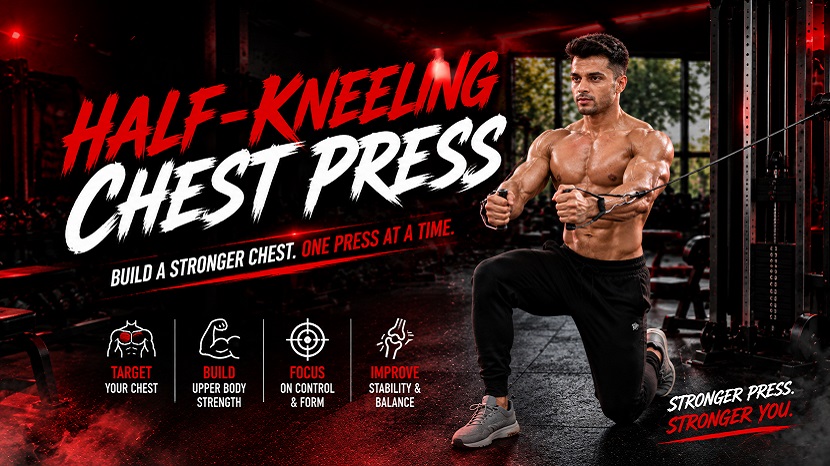
The half kneeling chest press is a smart chest press exercise that trains your upper body while challenging your core at the same time. Unlike traditional bench presses or standing cable presses, this move puts you in a half kneeling position. One knee stays on the ground while the other foot plants forward. You then perform a single arm chest press using a cable machine or resistance band.
This setup creates an uneven load that tries to pull or twist your body. Your core must work hard to stay stable. That is why trainers call it an anti-rotation chest press. The exercise builds pressing strength in the chest while teaching the body to resist unwanted movement. It fits perfectly into any functional chest workout because it mimics real-life pushing actions that happen while the body stays balanced.
Many people use the half kneeling cable chest press because the cable gives constant tension through the full range of motion. You can also do it with a resistance band for a portable option at home or while traveling. The move helps fix strength differences between your left and right sides. It also improves posture and shoulder stability. Whether you are a beginner or an experienced lifter, the half kneeling chest press adds variety and real-world strength to your training.
The Unique Benefits of the Half Kneeling Chest Press
The half kneeling chest press delivers more than just bigger chest muscles. It creates a true chest and core workout in one efficient movement. The offset load from the cable forces your deep core muscles to stay tight. This builds better stability that carries over to sports, lifting, and everyday activities like carrying groceries or pushing a heavy door.
Because you press with one arm at a time, the exercise belongs to the family of unilateral chest exercises. Unilateral training helps correct muscle imbalances. If one side of your chest or shoulder is weaker, this move highlights it and gives that side extra work. Over time, both sides become more even in strength and size.
Another big benefit comes from the position itself. The back leg stays in a stretched hip flexor position. Many people who sit a lot develop tight hip flexors. The half kneeling chest press gently opens those hips while you train your upper body. You also learn to keep your ribs down and pelvis neutral. This improves overall posture and reduces lower back strain during other lifts.
Athletes in sports that involve throwing, punching, or swinging love this exercise. It trains the ability to produce force with the chest and arms while the core stays rock solid. That combination leads to more powerful and safer movements on the field or court. Regular people also notice better balance and less shoulder discomfort after adding the half kneeling chest press to their routine.
Muscles Targeted in the Half Kneeling Cable Chest Press
The half kneeling cable chest press works several important muscle groups together. The main movers are the pectoralis major and pectoralis minor in the chest. These muscles drive the pressing action forward. The triceps on the back of the upper arm help straighten the elbow. The front part of the shoulders, called the anterior deltoids, also assist in the movement.
What makes this chest press variation special is the heavy involvement of the core. The obliques on the sides of your waist work hard to stop your torso from rotating toward or away from the cable. The deep transverse abdominis and rectus abdominis keep your spine stable and prevent your lower back from arching. Your glutes and hips stay active to maintain a strong base in the half kneeling stance.
Because the load is offset, smaller stabilizing muscles around the shoulder blade and rotator cuff also get trained. This leads to healthier shoulders over time. The exercise does not isolate one muscle. Instead, it teaches your body to work as an integrated unit. That is why it ranks high in any serious functional chest workout program.
How to Do the Half Kneeling Chest Press Step by Step
Follow these clear steps to perform the half kneeling chest press safely and effectively.
- Step 1: Set the cable pulley at about chest height. Attach a single handle. Choose a light to moderate weight to start so you can focus on form.
- Step 2: Kneel on your left knee with your right foot planted forward. Both knees should form roughly 90-degree angles. Keep your torso tall and ribs down.
- Step 3: Grab the handle with your left hand. Your palm faces forward or slightly down. Place your right hand on your ribs or extend it out for balance.
- Step 4: Brace your core tightly. Squeeze your glutes. Make sure your hips and shoulders stay square to the front.
- Step 5: Press the handle straight forward until your arm is fully extended. Keep pressing through the chest. Avoid twisting or leaning.
- Step 6: Slowly bring the handle back to the starting position with control. Feel the stretch in your chest. Do not let your elbow drop below shoulder height.
- Step 7: Complete all reps on one side, then switch to the opposite half kneeling position and repeat with the other arm.
Perform 8 to 12 controlled reps per side. Rest 60 to 90 seconds between sets. Always prioritize quality movement over heavy weight.
Proper Form and Technique for Maximum Results
Good form turns the half kneeling chest press into a highly effective anti-rotation chest press. Start every rep with a strong brace. Imagine someone is about to punch your stomach. Tighten your entire midsection before you move the weight.
Keep your front shin vertical and your back knee directly under your hip. Do not let your front knee cave inward. Your weight should stay balanced between the front foot and the back knee. As you press, think about driving your fist straight ahead like you are punching through a wall. At the end of the press, give your chest a gentle squeeze for one second.
On the way back, control the movement for two to three seconds. This slow lowering phase builds more muscle and teaches better body control. Breathe out steadily as you press forward. Breathe in as you return the handle. Never hold your breath. If you feel your lower back start to arch, lighten the weight and reset your core brace.
Keep your shoulders down and away from your ears. The working shoulder blade should move naturally with the arm but stay stable against your ribcage. These small details separate a good set from a great one and protect your joints during every single arm chest press repetition.
Common Mistakes and How to Fix Them in Unilateral Chest Exercises
Even experienced lifters make errors with the half kneeling chest press. Here are the most common ones and simple fixes.
- Rotating the torso: Many people twist toward the cable or away from it. Fix this by placing one hand on your ribs and keeping both shoulders pointing forward the entire time.
- Arching the lower back: This happens when the core is not braced. Lighten the weight, squeeze your glutes harder, and pull your ribs down toward your pelvis before each rep.
- Using too much weight: Heavy loads ruin form fast. Start lighter than you think you need. Master the movement pattern first, then add weight gradually.
- Letting the elbow drop too low: This reduces chest activation and stresses the shoulder. Keep the elbow at or slightly below shoulder height at the bottom position.
- Rushing the movement: Fast reps reduce time under tension and increase injury risk. Slow down the lowering phase and pause briefly at the top of each press.
- Poor half kneeling setup: If your hips are uneven or your front foot is too far forward, balance suffers. Reset your position so both legs form clean 90-degree angles.
Filming yourself from the side or front helps you spot these issues quickly. Small corrections lead to big improvements in both safety and results.
Equipment Needed for the Half Kneeling Cable Chest Press
The classic version uses a cable machine with an adjustable pulley. Set the pulley at chest height or slightly lower for a flat press feel. A single D-handle or rope attachment works well. Most commercial gyms have this equipment.
For home workouts or travel, a resistance band is an excellent substitute. Anchor the band to a sturdy door, railing, or heavy piece of furniture at chest height. The band provides increasing resistance as you press forward, which is great for muscle growth. Choose a band with moderate tension so you can complete full sets with good form.
Some people try a half kneeling dumbbell chest press version. Hold a light dumbbell at chest level and press it forward while staying in the half kneeling stance. This version gives less anti-rotation challenge because there is no anchored cable pulling sideways. It still works the chest and teaches stability, but the cable or band version remains superior for core engagement.
You may also want a soft mat or pad under your back knee for comfort during longer sets. That is all you really need to get started with this effective chest press variation.
Effective Variations of This Chest Press Variation
Once you master the basic half kneeling chest press, try these progressions and variations to keep making progress.
- Low to high angle: Set the cable lower and press upward. This variation emphasizes the upper chest fibers while still challenging core stability.
- High to low angle: Set the cable higher and press slightly downward. This targets the lower chest and can feel more comfortable for some shoulder positions.
- Resistance band version: Use a band anchored behind you or to the side. This option is perfect for home training and adds accommodating resistance.
- Tall kneeling press: Rise up so both knees are off the ground but you stay in a tall kneeling stance. This increases the stability demand on your core and legs.
- Half kneeling with opposite reach: After pressing forward, reach the non-working arm forward or overhead. This adds extra core and shoulder stability work.
- Isometric hold at end range: Press out and hold the fully extended position for 5 to 10 seconds before returning. This builds serious strength and endurance in the chest and core.
Rotate through two or three of these variations across different training sessions. This keeps your body adapting and prevents boredom in your functional chest workout.
Programming Tips for Your Functional Chest Workout
Place the half kneeling chest press after your main compound pressing movements like bench press or push-ups. It works well as a second or third exercise in a push-focused session. Aim for 3 to 4 sets of 8 to 12 reps per side. Rest 60 to 90 seconds between sets.
For strength goals, use slightly heavier resistance and lower reps (6 to 8 per side). For muscle growth, stay in the 8 to 12 rep range with moderate weight and good control. For endurance or core emphasis, go up to 12 to 15 reps with lighter resistance and shorter rest periods.
A simple push day example looks like this:
- Bench press or push-ups – 4 sets of 6 to 10 reps
- Overhead press – 3 sets of 8 to 10 reps
- Half kneeling cable chest press – 3 sets of 10 reps per side
- Triceps extensions or dips – 3 sets of 10 to 12 reps
Perform this workout once or twice per week. Allow at least 48 hours of recovery between similar sessions. Track your weights and reps over time. When you can complete all sets and reps with perfect form, increase the resistance slightly. This progressive approach leads to steady gains in both chest size and core strength.
Half Kneeling Chest Press vs Other Chest Exercises Comparison
Here is a clear comparison to help you understand where the half kneeling chest press fits among popular chest movements.
| Exercise | Primary Focus | Core Challenge | Equipment | Best Used For | Difficulty |
|---|---|---|---|---|---|
| Half Kneeling Chest Press | Chest + Core Stability | High (Anti-Rotation) | Cable or Band | Functional strength, imbalance correction, posture | Intermediate |
| Flat Bench Press | Overall Chest Mass | Low to Moderate | Barbell or Dumbbells | Building raw pressing strength and size | Beginner to Advanced |
| Standing Cable Chest Press | Chest with some Core | Moderate | Cable Machine | Constant tension and shoulder health | Beginner to Intermediate |
| Pallof Press | Core Anti-Rotation | Very High | Cable or Band | Pure core stability and injury prevention | Beginner to Advanced |
The half kneeling chest press stands out because it combines meaningful chest work with serious core training in a single exercise. It is not meant to replace heavy bench pressing. Instead, it complements bilateral lifts by adding stability and unilateral strength that many traditional chest exercises miss.
Safety Considerations and Who Can Benefit from This Chest and Core Workout
The half kneeling chest press is generally safe for healthy individuals when performed with good form. Always warm up your shoulders, chest, and hips before starting. Perform a few light sets with very little resistance to groove the movement pattern.
People with current shoulder injuries, wrist pain, or lower back issues should get clearance from a doctor or physical therapist before trying this exercise. If you feel sharp pain (not normal muscle fatigue), stop immediately and reassess your form or reduce the load.
This move works well for beginners who want to learn core bracing during pressing actions. It also suits intermediate and advanced lifters who need more core work or want to fix left-to-right strength differences. Office workers and athletes both benefit from the posture and stability improvements it provides.
Start conservatively. Use a weight that challenges you but never compromises your ability to keep your core braced and hips square. Progress slowly over weeks and months. Consistency with proper technique always beats heavy weights with sloppy form.
Final Thoughts on Adding the Anti-Rotation Chest Press to Your Routine
The half kneeling chest press is one of the smartest chest press variations you can add to your training. It builds a stronger, more balanced chest while turning every set into a genuine chest and core workout. The anti-rotation chest press demand improves stability that shows up in sports, lifting, and daily life.
Because it is a single arm chest press performed in a half kneeling position, it also helps correct imbalances and teaches better body control. Whether you train with cables at the gym or bands at home, this exercise delivers excellent value with minimal equipment.
Start with light resistance and focus on perfect form. Once the movement feels natural, gradually increase the challenge through heavier weight, slower tempos, or the variations shared earlier. Over time you will notice a stronger chest, tighter core, better posture, and more confident pressing power.
Make the half kneeling chest press a regular part of your functional chest workout routine. Your body will thank you with improved strength, stability, and resilience that lasts far beyond the gym.
Frequently Asked Questions (FAQs)
1. What is the Half-Kneeling Chest Press?
Answer: The Half-Kneeling Chest Press is a functional, unilateral chest exercise performed in a split-kneeling stance using a cable machine. You press a single handle forward while your body works hard to resist the off-center pull created by training only one side at a time. This combination of chest pressing and intense core stabilization makes it an excellent accessory movement for building strength, balance, and real-world athleticism.
2. What muscles does the Half-Kneeling Chest Press target?
Answer: The primary muscles worked are the pectoralis major (chest), triceps brachii, and anterior deltoids. Because of the half-kneeling position and unilateral load, it also heavily recruits the core stabilizers — including the rectus abdominis, internal and external obliques, transverse abdominis — along with the glutes, hip stabilizers, and scapular muscles. It is one of the best chest exercises for training anti-rotation and anti-lateral flexion strength at the same time.
3. What are the main benefits of the Half-Kneeling Chest Press?
Answer: This exercise delivers chest development while dramatically improving core strength and stability. It corrects left-to-right muscle imbalances, enhances functional pushing power, and builds better posture and hip stability. Many lifters find it joint-friendlier than heavy barbell bench pressing because you can control the path and avoid excessive shoulder stress. It also teaches proper bracing that carries over to sports and daily life.
4. How do you perform the Half-Kneeling Chest Press with proper form?
Answer: Set a cable pulley at roughly chest height and attach a single handle. Grab the handle with one hand and step into a half-kneeling position with the knee on the same side as the working arm down on the floor (or the most stable side for you). Place your front foot flat and create 90-degree angles at both knees. Keep your torso tall, hips square, and ribs stacked over your hips. Brace your core hard and squeeze the glute of the down leg. Start with the handle at upper-chest level. Press the handle forward and slightly across your midline in a controlled path until your arm is extended. Pause and squeeze your chest, then slowly return to the start position without twisting your torso. Complete all reps on one side before switching.
5. What equipment do I need for the Half-Kneeling Chest Press?
Answer: You need a cable machine with an adjustable pulley and a single-grip handle attachment. A knee pad or mat is optional but recommended for comfort. If you do not have access to cables, you can perform a similar movement with a resistance band anchored at chest height or use a dumbbell in a half-kneeling position (though the cable version provides the most constant tension and stability challenge).
6. Is the Half-Kneeling Chest Press suitable for beginners?
Answer: Yes, it is beginner-friendly when you start with very light weight or even just the cable handle with no added plates. The key is to first master the half-kneeling posture and strong core brace before adding load. Many beginners actually benefit more from this exercise than heavy bench pressing because it teaches stability and proper bracing from day one. Focus on quality of movement over quantity of weight.
7. What are the most common mistakes to avoid with the Half-Kneeling Chest Press?
Answer: The biggest mistakes include twisting or rotating the torso toward the pressing side, failing to brace the core and glute before pressing, using momentum or leaning, choosing a weight that is too heavy, and rushing the return (eccentric) phase. Other errors are letting the front knee cave inward, arching the lower back, or setting the cable height incorrectly. Always film yourself from the side and front, start light, and cue “ribs down, glute tight, press from the chest without twisting.”
8. How does the Half-Kneeling Chest Press compare to the Bench Press and Standing Chest Press?
Answer: The traditional Bench Press allows the heaviest loads for pure chest hypertrophy but provides external support, so core demand is low and imbalances can hide. The Standing Chest Press adds some stability challenge but still allows leg drive and sway. The Half-Kneeling version locks the lower body more effectively, creates a much greater anti-rotation and anti-lateral flexion demand on the core, and forces each side to work independently. Use the bench press for maximum strength and size, and the half-kneeling cable version as a powerful accessory for functional strength, stability, and balanced development.
9. Can the Half-Kneeling Chest Press help fix muscle imbalances?
Answer: Yes, it is one of the best exercises for correcting left-to-right imbalances. Because you train one arm at a time, the stronger side cannot compensate for the weaker side the way it does during barbell bench pressing. Over several weeks of consistent unilateral work, most people notice improved symmetry in chest size, pressing strength, shoulder stability, and even core control.
10. What sets, reps, and rest periods are recommended?
Answer: For most people training for muscle growth and strength, perform 3–4 sets of 8–12 controlled reps per side. For endurance and stability emphasis, use 2–3 sets of 12–15+ reps with a lighter load. Rest 60–90 seconds between sets. Always train both sides equally. Place this exercise after your main compound pressing movement (bench press or dumbbell press) or use it as a finisher on chest or upper-body days. Progress by adding small amounts of weight or slowing the lowering phase to 3 seconds.
11. What are some effective variations of the Half-Kneeling Chest Press?
Answer: Popular variations include the Half-Kneeling Landmine Press (angled bar path that targets upper chest and shoulders), Half-Kneeling Dumbbell Press (great when cables are unavailable), Tall-Kneeling Chest Press (both knees down for a different stability challenge), and low-to-high or high-to-low cable fly variations in the half-kneeling position. Advanced trainees can add a slight rotation at the end of the press or perform the movement with a resistance band for travel-friendly training.
12. Is the Half-Kneeling Chest Press safe if I have shoulder or back issues?
Answer: It is often safer and more joint-friendly than heavy barbell bench pressing for people with shoulder or lower-back concerns because you control the range of motion and can avoid excessive horizontal abduction. However, anyone with existing shoulder impingement, rotator cuff problems, or significant back pain should consult a doctor or physical therapist before trying it. Start with very light resistance, focus on pain-free movement, and stop immediately if you feel sharp pain. Proper core bracing actually helps support the spine during the exercise.