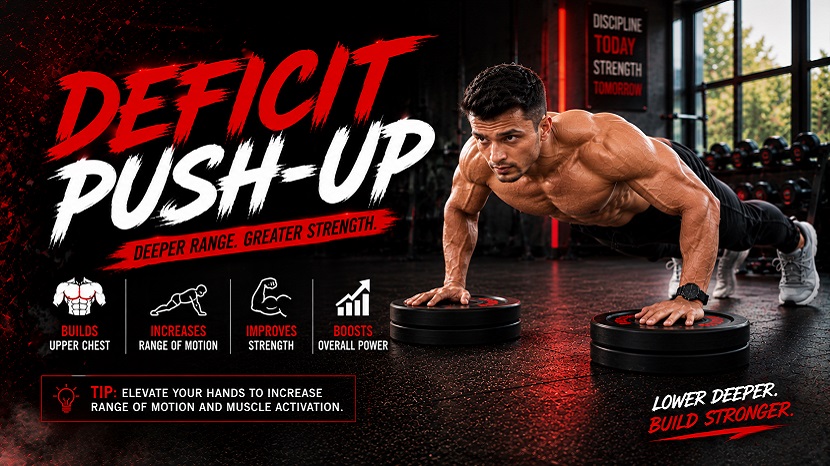
If you have already built a solid foundation with regular push ups and want to push your chest development further, deficit push ups represent one of the smartest progressions available. This advanced bodyweight movement increases your range of motion by elevating your hands on stable platforms. The result is a deeper stretch through the chest at the bottom of every repetition.
Many people searching for effective bodyweight chest exercises eventually discover deficit push ups because they deliver noticeable improvements in muscle size and strength when performed correctly. Whether you train at home or in a commercial gym, this exercise requires very little equipment yet creates a powerful training stimulus.
In the sections below you will learn exactly how to do deficit push ups, understand the deficit push up muscles worked, explore the main deficit push ups benefits, master proper deficit push up form, and see how to fit this movement into a complete deficit push ups chest workout. You will also discover useful advanced push up variations and push up variations that keep training fresh and challenging.
Contents Overview
- Understanding Deficit Push Ups
- Deficit Push Up Muscles Worked
- Key Deficit Push Ups Benefits
- How to Do Deficit Push Ups Step by Step
- Mastering Proper Deficit Push Up Form
- Common Mistakes and How to Fix Them
- Deficit Push Ups Versus Regular Push Ups
- Best Equipment for Deficit Push Ups
- Advanced Push Up Variations and Progressions
- Building a Complete Deficit Push Ups Chest Workout
- Final Thoughts
- FAQs
Understanding Deficit Push Ups
A deficit push up is simply a push up performed with your hands placed on raised platforms instead of flat on the floor. The word "deficit" refers to the extra space created between your chest and the floor. Because your hands sit higher, your chest can travel several inches lower than it normally would during a standard push up.
This small change makes a big difference. The increased depth forces your chest muscles to work through a longer range of motion. You get a stronger stretch at the bottom and a more complete contraction at the top. Many experienced lifters consider this one of the best bodyweight chest exercises for building both size and strength without any weights.
The movement looks similar to a regular push up at first glance. However, the extra range of motion turns it into a more advanced exercise. It demands better shoulder mobility, stronger core stability, and stricter overall body control. Beginners should first master at least ten to fifteen clean regular push ups before attempting the deficit version.
Deficit Push Up Muscles Worked
Understanding the deficit push up muscles worked helps you appreciate why this exercise feels so effective. The primary movers remain the same as in a standard push up, but the deeper range of motion increases the demand on several muscle groups.
- Pectoralis major (the main chest muscle) receives a greater stretch and stronger contraction because of the increased depth.
- Anterior deltoids (front of the shoulders) work harder to control the deeper lowering phase.
- Triceps brachii extend the elbows through a longer range, leading to more complete development.
- Core muscles (abdominals and obliques) stay braced longer to maintain a rigid body line.
- Serratus anterior and rhomboids get extra work from the greater scapular movement required at the bottom position.
The deeper stretch position is especially valuable. Recent training research shows that muscles grow better when they are trained in their lengthened state. By letting your chest drop well below your hands, you place the pectorals under tension where they are most stretched. This is one reason many people notice faster chest development after adding deficit push ups to their routine.
Key Deficit Push Ups Benefits
The deficit push ups benefits go well beyond simple muscle growth. Here are the main advantages that make this exercise worth learning.
- Greater range of motion allows a deeper chest stretch, which improves muscle flexibility and can enhance overall shoulder mobility over time.
- Increased muscle activation occurs because the chest, shoulders, and triceps must control and reverse a longer movement path.
- Better hypertrophy stimulus comes from training the muscles in their most lengthened position, a key driver of muscle growth.
- Improved pushing strength transfers to other pressing movements such as the bench press and overhead press.
- Core and stability gains develop because you must fight harder to keep your body straight throughout the extended range.
- Minimal equipment needed makes this an excellent home workout option that still feels challenging.
Another often overlooked benefit is the mental challenge. Performing deficit push ups with good control builds discipline and body awareness. You learn to move slowly and deliberately rather than rushing through repetitions. These qualities carry over into every other exercise you perform.
How to Do Deficit Push Ups Step by Step
Learning how to do deficit push ups correctly is essential for both safety and results. Follow these steps in order.
- Step 1: Choose and set up your equipment. Place two stable platforms of equal height on the floor. Good options include hex dumbbells standing on end, weight plates stacked evenly, or sturdy yoga blocks. Start with a modest height of two to four inches.
- Step 2: Get into the starting position. Position your hands on the platforms slightly wider than shoulder width. Extend your legs behind you so your body forms a straight line from head to heels. Keep your feet together or hip-width apart.
- Step 3: Brace your entire body. Squeeze your glutes, tighten your abdominals, and pull your shoulder blades slightly down and back. Your head should stay in a neutral position with your gaze slightly ahead on the floor.
- Step 4: Lower with control. Bend your elbows and lower your chest toward the floor. Allow your chest to drop below the level of your hands. Keep your elbows at roughly a 45-degree angle from your torso rather than flaring them out wide.
- Step 5: Reach the bottom position. Go as deep as your mobility comfortably allows. Your chest should be noticeably lower than your hands. Pause for one second while maintaining full body tension.
- Step 6: Press back up. Drive through your palms and extend your elbows to return to the starting position. Keep your core and glutes tight so your hips do not sag or rise.
- Step 7: Complete the repetition. Finish with your arms fully extended but do not lock your elbows harshly. Reset your shoulder position and prepare for the next repetition.
Perform each repetition slowly and with full control. Quality always matters more than quantity with this exercise.
Mastering Proper Deficit Push Up Form
Good deficit push up form separates an effective exercise from one that can cause discomfort. Focus on these key technical points during every set.
Maintain a rigid plank position from start to finish. Your body should move as one unit rather than segmenting at the hips. If your lower back sags, reduce the deficit height or perform the movement on your knees until your core strength improves.
Control the eccentric (lowering) phase. Take two to three seconds to descend. This increases time under tension and protects your shoulder joints. Explosive pressing on the way up is acceptable once you have mastered the controlled lowering.
Keep your shoulder blades moving naturally. At the bottom they retract slightly as your chest opens. At the top they protract forward as you push away. Avoid pinning them down the entire time or letting them shrug toward your ears.
Breathe correctly. Inhale as you lower your body. Exhale forcefully as you press back up. This breathing pattern helps maintain core stability and power output.
Common Mistakes and How to Fix Them
Even experienced trainees make errors with deficit push ups. Here are the most frequent problems and simple corrections.
- Sagging hips or arched lower back. This usually happens when the deficit is too high for your current core strength. Lower the platforms or perform the exercise on your knees until you can maintain a straight body line.
- Elbows flaring out wide. This increases shoulder stress. Keep your elbows at about 45 degrees from your sides throughout the movement. Imagine trying to tuck your elbows toward your ribcage.
- Partial range of motion. Many people do not go deep enough or do not fully extend at the top. Focus on touching your chest as low as safely possible and locking out your arms completely on every rep.
- Rushing the movement. Fast reps reduce the stretch benefit. Slow the lowering phase deliberately and pause at the bottom for one full second.
- Using unstable equipment. Wobbly platforms or round dumbbells that roll can lead to injury. Choose flat, stable surfaces that will not shift during your set.
Record yourself on video from the side occasionally. Watching your own form helps you spot issues that feel normal while you are training.
Deficit Push Ups Versus Regular Push Ups
Understanding how deficit push ups compare with regular push ups helps you decide when to use each variation.
| Aspect | Regular Push Ups | Deficit Push Ups |
|---|---|---|
| Range of Motion | Limited by the floor | Increased by several inches |
| Chest Stretch | Moderate | Significantly greater |
| Difficulty Level | Beginner to advanced | Intermediate to advanced |
| Muscle Emphasis | Standard chest, shoulders, triceps | Enhanced chest stretch and mid-back involvement |
| Equipment Needed | None | Two stable platforms |
| Best For | Building foundational strength and endurance | Breaking plateaus and maximizing hypertrophy |
Regular push ups remain excellent for volume work and conditioning. Deficit push ups shine when your goal is maximum chest development and you have already built a base of strength. Many people use both variations in the same workout for different purposes.
Best Equipment for Deficit Push Ups
You do not need expensive gear to perform deficit push ups effectively. Here are the most practical and stable options.
- Hex dumbbells placed on their ends provide a comfortable grip and stable base. Choose a weight that will not tip over.
- Weight plates (bumper plates work especially well) can be stacked to create the exact height you need.
- Yoga blocks or foam blocks offer a flat, non-slip surface and are easy to adjust.
- Push-up bars or parallettes give extra height and a neutral grip that many people find more comfortable on the wrists.
- Low plyo boxes or sturdy step platforms work well in commercial gyms when you want a larger deficit.
Start conservatively with a two- to three-inch deficit. Increase the height only after you can perform clean sets with full range of motion and no form breakdown. A small deficit is often more effective than an extreme one because it allows better control and deeper stretch without compromising shoulder safety.
Advanced Push Up Variations and Progressions
Once you feel comfortable with standard deficit push ups, you can explore advanced push up variations that add new challenges. These push up variations keep training interesting and continue driving progress.
- Paused deficit push ups. Add a three-second pause at the bottom to increase time under tension and improve strength in the weakest position.
- Weighted deficit push ups. Wear a weighted vest or have a training partner place a plate on your upper back for added resistance.
- Deficit push ups with chains. Drape chains across your back for accommodating resistance that gets heavier as you press up.
- Feet-elevated deficit push ups. Raise your feet on a bench while keeping hands in deficit position for even greater range and upper chest emphasis.
- Archer deficit push ups. Shift most of your weight to one arm at the bottom to increase unilateral strength demands.
Progress slowly. Add one new element at a time and always prioritize perfect form over extra difficulty. These advanced push up variations can keep your chest training productive for many months or even years.
Building a Complete Deficit Push Ups Chest Workout
A well-designed deficit push ups chest workout balances pushing volume with pulling work and recovery. Here is a simple yet effective template you can follow.
Perform this routine two times per week with at least two days between sessions. Warm up thoroughly with arm circles, band pull-aparts, and a few light regular push ups before starting the working sets.
- Deficit Push Ups: 4 sets of 6 to 10 repetitions. Focus on full range and controlled tempo. Rest 2 minutes between sets.
- Regular or Incline Push Ups: 3 sets of 10 to 15 repetitions. Use these for additional volume after the heavier deficit work.
- Dumbbell or Resistance Band Rows: 3 sets of 10 to 12 repetitions per arm. Pulling exercises balance the pushing and protect shoulder health.
- Chest Stretch: Hold a doorway or wall stretch for 30 seconds per side after your workout.
Track your performance each session. When you can complete all sets and reps with perfect form and still have energy left, increase the deficit height slightly or add a pause at the bottom. Consistent progression is the real key to long-term chest development.
Final Thoughts
Deficit push ups offer a simple yet highly effective way to take your chest training to the next level. By increasing range of motion, you create a stronger stretch and more complete muscle contraction with nothing more than your body weight and a pair of stable platforms.
Remember that results come from consistent practice with excellent form. Master the basics first, then gradually add difficulty through greater deficit height, pauses, or external load. Pair this exercise with balanced pulling work, good nutrition, and adequate recovery, and you will see steady improvements in both strength and chest size.
Whether your goal is building muscle, improving pushing power, or simply adding variety to your bodyweight training, deficit push ups deserve serious consideration. Start today with a modest setup, focus on quality repetitions, and enjoy the progress that follows.
Frequently Asked Questions (FAQs)
1. What is a Deficit Push-Up?
Answer: A Deficit Push-Up is an advanced bodyweight chest exercise performed by placing your hands on elevated platforms such as push-up bars, dumbbells, or blocks. This elevation creates extra space beneath your chest, allowing it to travel below the level of your hands and achieve a greater range of motion than a standard push-up. The movement places increased stretch and tension on the pectoral muscles, making it highly effective for building chest size, strength, and definition.
2. How to Do Deficit Push-Ups with Proper Form?
Answer: Place two stable elevated platforms shoulder-width apart on the floor. Assume a high plank position with your hands on the platforms, body straight from head to heels, and core braced. Lower your chest slowly below the height of the platforms by bending your elbows to about 45 degrees. Keep your elbows tucked rather than flared. Push explosively through your palms to return to the starting position while maintaining a rigid body line. Inhale on the way down and exhale forcefully on the way up. Perform each repetition with full control and complete range of motion.
3. What Muscles Are Worked by Deficit Push-Ups?
Answer: Deficit Push-Ups primarily target the pectoralis major, with extra emphasis on the lower and inner chest fibers because of the deeper stretch. Secondary muscles include the anterior deltoids (front shoulders), triceps, and serratus anterior. The core muscles (rectus abdominis, obliques, and transverse abdominis) work hard to keep the body stable in a straight plank position throughout the movement.
4. What Are the Benefits of Deficit Push-Ups?
Answer: Deficit Push-Ups deliver superior chest activation and hypertrophy potential due to the increased range of motion and stretch. They build greater pushing strength, improve shoulder stability and scapular control, enhance mind-muscle connection with the chest, and help break through plateaus from regular push-ups. The exercise also increases time under tension, leading to better muscle growth and upper body development overall.
5. Can Beginners Do Deficit Push-Ups?
Answer: Deficit Push-Ups are best suited for intermediate and advanced trainees who can already perform at least 10-15 clean regular push-ups. Beginners should first master standard push-ups, knee push-ups, or incline push-ups to build foundational strength and technique. Once ready, start with a very small deficit (1-2 inches) and focus strictly on form before gradually increasing the height or volume.
6. What Equipment Do You Need for Deficit Push-Ups?
Answer: You can use push-up bars, parallettes, hexagonal dumbbells stood on their ends, sturdy yoga blocks, or thick books. The ideal starting height is 3 to 6 inches. The most important requirement is stability — the platforms must not wobble or slip. If you do not have dedicated equipment, two stable low chairs placed securely back-to-back can work, but always test stability before starting the set.
7. What Are Common Mistakes to Avoid When Performing Deficit Push-Ups?
Answer: The most frequent errors include flaring the elbows wide (stressing the shoulders), letting the hips sag or pike upward (losing core tension), failing to lower the chest below the platforms (missing the deficit benefit), using momentum instead of controlled movement, and skipping wrist and shoulder warm-ups. Fix these by keeping elbows at 45 degrees, bracing the core hard, moving slowly especially on the lowering phase, and always warming up properly before training.
8. How Many Sets and Reps Should You Do for Deficit Push-Ups?
Answer: Perform 3 to 5 sets of 6 to 12 repetitions depending on your strength level and goals. Beginners progressing into this variation should start with 3 sets of 5-8 quality reps. Advanced athletes can use slower tempos, pauses at the bottom, or higher volume. Rest 60-90 seconds between sets. Include Deficit Push-Ups 1-2 times per week on chest or push days, allowing at least 48 hours of recovery between sessions.
9. How Do Deficit Push-Ups Compare to Regular Push-Ups?
Answer: The main difference is the greater range of motion in Deficit Push-Ups, which creates a deeper stretch in the chest and leads to higher muscle activation and growth potential. They are significantly more challenging and better for hypertrophy but require more shoulder mobility and core strength. Regular push-ups are more beginner-friendly and excellent for building foundational pushing strength, while deficit variations are ideal for breaking plateaus and maximizing chest development.
10. What Safety Precautions Should You Take with Deficit Push-Ups?
Answer: Always perform a thorough warm-up with wrist circles, shoulder rolls, and band work. Start with a small deficit and increase height gradually as your mobility and strength improve. Never force depth if you feel sharp pain in the shoulders or wrists (mild stretch discomfort is normal). Maintain a neutral spine and strong core at all times. If you have existing shoulder, wrist, or elbow issues, consult a doctor or qualified trainer before attempting this exercise. Use only stable, non-slip surfaces.