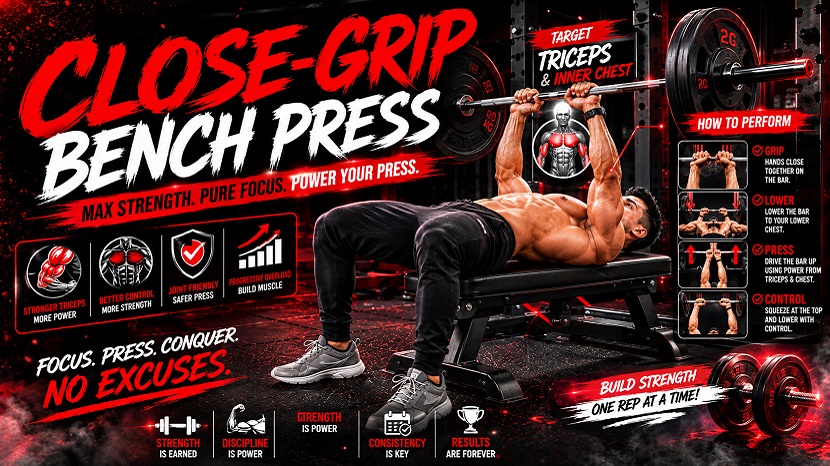
The close grip bench press stands out as one of the most effective compound movements you can add to any close grip bench press workout. While many people think of it only as a triceps exercise, it delivers excellent results for chest development too. This variation shifts emphasis toward the triceps while still engaging the upper chest and front shoulders, making it a smart choice for balanced upper body strength and size.
If you have been searching for how to do close grip bench press with perfect technique, or you want to understand close grip bench press muscles worked and the real close grip bench press benefits, you are in the right place. This guide covers everything from proper close grip bench press form and close grip bench press technique to smart programming in your chest routine. You will also see a clear close grip bench press vs wide grip comparison and practical variations that keep training fresh and effective.
Contents Overview
- What Is the Close Grip Bench Press
- Close Grip Bench Press Muscles Worked
- Close Grip Bench Press Benefits for Chest and Triceps Development
- How to Do Close Grip Bench Press Correctly
- Mastering Close Grip Bench Press Form and Technique
- Common Mistakes in Close Grip Bench Press and How to Fix Them
- Close Grip Bench Press vs Wide Grip Bench Press Comparison
- Effective Variations of the Close Grip Bench Press
- Incorporating Close Grip Bench Press into Your Chest Workout Routine
- Safety Tips and Injury Prevention for Close Grip Bench Press
- FAQs
What Is the Close Grip Bench Press
The close grip bench press is a barbell pressing variation performed on a flat bench with a narrower hand placement than the standard bench press. Instead of gripping the bar at or outside shoulder width, you bring your hands in to roughly shoulder width or slightly inside. This simple change in grip dramatically increases activation in the triceps while still working the chest and shoulders.
Many lifters include the narrow grip bench press in their routines because it builds pressing strength that carries over to the regular bench press. The movement follows the same basic pattern as a standard bench press but with elbows kept tighter to the body. This makes it especially useful for people who want bigger arms without spending extra time on isolation exercises alone.
Close Grip Bench Press Muscles Worked
Understanding close grip bench press muscles worked helps you appreciate why this exercise delivers such good results. It is a true compound movement that trains multiple muscle groups at once.
| Muscle Group | Role in the Movement | Level of Activation |
|---|---|---|
| Triceps Brachii | Primary mover – extends the elbows and provides most of the pressing power | Very High |
| Pectoralis Major (Upper Chest) | Assists in pressing the bar upward, especially the clavicular head | High |
| Anterior Deltoids | Helps stabilize the shoulders and contributes to the pressing motion | Moderate to High |
| Core and Upper Back | Maintains a stable platform and keeps shoulder blades retracted | Moderate |
The triceps receive the greatest emphasis, which is why the close grip bench press triceps combination is so popular among lifters who want thicker arms. The upper chest still gets meaningful work, making this exercise valuable even on chest-focused training days.
Close Grip Bench Press Benefits for Chest and Triceps Development
The close grip bench press benefits go far beyond simply adding size to your arms. Because it is a compound lift, you can use heavier loads than most isolation triceps exercises, creating greater mechanical tension and muscle growth stimulus.
Stronger triceps directly improve your performance on the regular bench press. Many lifters find that adding close grip bench press work helps them blast through sticking points near the top of the movement. The exercise also places less stress on the shoulders compared with very wide grips, making it a joint-friendly option for long-term training.
Another key benefit is improved upper chest development. The narrower grip and tucked elbow position recruit the clavicular portion of the pectoralis major effectively. This helps create a fuller, more balanced chest appearance when combined with flat and incline pressing movements.
Finally, the close grip bench press workout builds functional pressing strength that transfers to sports and daily activities involving pushing movements with the arms closer together.
How to Do Close Grip Bench Press Correctly
Learning how to do close grip bench press properly is essential for both results and safety. Follow these steps carefully and start with light weight until the movement feels natural.
- Step 1: Lie flat on a sturdy bench with your feet planted firmly on the floor. Position your eyes directly under the barbell.
- Step 2: Grip the bar with your hands at shoulder width or slightly narrower. Your index fingers should be roughly in line with the outer edges of your shoulders or just inside. Wrap your thumbs securely around the bar.
- Step 3: Retract and depress your shoulder blades by pulling them down and together as if you are trying to squeeze a pencil between them. Maintain this tight upper back position throughout the set.
- Step 4: Unrack the bar with help from a spotter if needed and hold it directly above your lower chest with arms fully extended.
- Step 5: Take a deep breath, brace your core, and lower the bar in a controlled manner toward the base of your sternum. Keep your elbows tucked close to your sides at about a 30 to 45 degree angle from your torso.
- Step 6: Touch the bar lightly to your lower chest, then drive it upward explosively by extending your elbows and pressing yourself into the bench. Think about pushing the bar toward the ceiling rather than simply pressing it up.
- Step 7: Exhale at the top and repeat for the desired number of repetitions. Avoid locking your elbows completely if you want to keep tension on the triceps.
Perform each repetition with control. The entire movement should feel smooth and powerful rather than rushed or jerky.
Mastering Close Grip Bench Press Form and Technique
Good close grip bench press form comes down to a few key technical points that separate effective reps from wasted effort or injury risk.
Grip width is critical. Too narrow and you place excessive stress on the wrists and inner elbows. Too wide and you lose the triceps emphasis. Most people do best with hands at true shoulder width or one to two inches inside. Experiment slightly while keeping wrists straight and the bar low in your palms.
Elbow position makes or breaks the exercise. Keep your elbows tucked toward your ribcage instead of letting them flare out. This protects the shoulders and forces the triceps to do more work. Imagine trying to put your elbows in your back pockets as you press.
Bar path should be relatively straight or with a very slight arc toward your lower chest on the way down. Touch the bar at the base of the sternum rather than high on the chest. This longer range of motion increases time under tension for the triceps.
Breathing and bracing matter too. Take a big breath before lowering the bar and hold it during the descent. Brace your core as if someone is about to punch you in the stomach. This creates a stable platform and protects your lower back.
Finally, use leg drive. Drive your feet into the floor and squeeze your glutes to create full-body tension. This transfers power from your legs into the press and helps you move more weight safely.
Common Mistakes in Close Grip Bench Press and How to Fix Them
Even experienced lifters make errors with the close grip bench press technique. Here are the most common problems and simple fixes.
- Gripping too narrow: Hands touching or extremely close often causes wrist pain and reduces strength. Widen your grip until wrists stay neutral and you can press comfortably.
- Elbows flaring out: This shifts tension away from the triceps and increases shoulder stress. Consciously tuck elbows and think about pulling the bar apart slightly with your hands.
- Bouncing the bar off the chest: Using momentum reduces muscle activation and raises injury risk. Lower the bar under full control and pause briefly on the chest before pressing up.
- Losing shoulder blade retraction: Shoulders rolling forward during the set destabilizes the movement. Reset your scapulae before every rep and maintain upper back tightness.
- Incomplete range of motion: Stopping short of touching the chest or not fully extending at the top limits triceps growth. Touch the bar lightly each rep and press to full arm extension.
- Using excessive arch or lifting the butt: An extreme lower back arch turns the movement into something else and can cause discomfort. Keep a natural mild arch in the upper back only and keep your glutes in contact with the bench.
Filming your sets from the side is one of the best ways to spot and correct these issues quickly.
Close Grip Bench Press vs Wide Grip Bench Press Comparison
Many lifters wonder about the differences when comparing close grip bench press vs wide grip. The table below shows a clear side-by-side view.
| Aspect | Close Grip Bench Press | Standard Bench Press | Wide Grip Bench Press |
|---|---|---|---|
| Primary Focus | Triceps and upper chest | Overall chest and triceps balance | Lower and mid chest |
| Shoulder Stress | Lower when form is good | Moderate | Higher, especially if grip is excessively wide |
| Best For | Triceps size, lockout strength, shoulder-friendly pressing | Overall chest mass and strength | Maximum chest stretch and width |
| Typical Grip Width | Shoulder width or slightly inside | Shoulder width to slightly outside | 1.5x shoulder width or more |
| Carryover to Regular Bench | Excellent for triceps weak point | Direct | Good for chest strength but may not help triceps lockout |
Most well-rounded programs include both close grip and standard width work. The narrow grip bench press excels at building the triceps that help you finish heavy bench presses, while wider grips give the chest a different stretch and stimulus.
Effective Variations of the Close Grip Bench Press
Once you master the basic barbell version, these variations can add variety and target slightly different qualities in your close grip bench press workout.
- Close Grip Dumbbell Bench Press: Allows each arm to work independently, helping fix strength imbalances while still targeting the triceps and upper chest.
- JM Press: A hybrid between close grip bench and triceps extension. Excellent for triceps isolation with some pressing strength carryover.
- Close Grip Floor Press: Limits range of motion to the top half, great for building lockout strength and reducing shoulder stress.
- Incline Close Grip Bench Press: Shifts more emphasis to the upper chest while keeping strong triceps involvement.
- Close Grip Smith Machine Press: Provides a fixed bar path, useful for beginners or when training without a spotter.
- Close Grip Pin Press or Board Press: Limits range of motion to focus on specific weak points in the press.
Rotate variations every 4 to 6 weeks to keep progress moving forward and prevent boredom or plateaus.
Incorporating Close Grip Bench Press into Your Chest Workout Routine
The close grip bench press fits beautifully into chest training days because strong triceps support heavier pressing overall. Here is a simple way to include it.
Perform the close grip bench press after your main flat or incline bench press work. Aim for 3 to 4 sets of 6 to 12 repetitions. Use a weight that challenges you while allowing perfect form. Rest 2 to 3 minutes between sets to maintain quality.
Sample chest workout structure:
- Flat Barbell Bench Press – 4 sets of 6 to 8 reps
- Incline Dumbbell Press – 3 sets of 8 to 10 reps
- Close Grip Bench Press – 3 to 4 sets of 8 to 12 reps
- Chest Fly or Pec Deck – 3 sets of 10 to 15 reps
- Optional triceps finisher such as pushdowns – 2 to 3 sets
For pure strength, stay in the 4 to 6 rep range with heavier loads. For hypertrophy, the 8 to 12 rep range works very well. Progress by adding small amounts of weight when you can complete all sets and reps with good technique.
Safety Tips and Injury Prevention for Close Grip Bench Press
Safety should always come first with any pressing movement. Start with a weight you can control for all prescribed reps and sets. Warm up thoroughly with lighter sets and shoulder mobility drills before loading the bar.
Listen to your body. Sharp pain in the shoulders, elbows, or wrists is a signal to stop and assess your form or reduce the load. Mild muscle fatigue is normal, but joint pain is not. If you have existing shoulder issues, consider starting with dumbbell variations or floor presses to find a comfortable range.
Always use a spotter or safety pins in the rack when working with heavy weights. Keep your ego in check and prioritize technique over the amount of weight on the bar. Consistent, smart training beats heavy, sloppy training every time.
Finally, give your joints and connective tissues time to adapt. Increase weight gradually over weeks and months rather than jumping up dramatically from one session to the next.
The close grip bench press is a powerful tool for building bigger arms, stronger presses, and a more balanced chest. When you combine proper close grip bench press form with smart programming, you will see steady progress in both strength and muscle size. Start incorporating it into your close grip bench press workout routine today and experience the difference it makes in your pressing power and arm development.
Frequently Asked Questions (FAQs)
1. What is the close-grip bench press exercise?
Answer: The close-grip bench press is a compound barbell exercise performed while lying on a flat bench. It uses a narrower hand placement than the traditional bench press, typically shoulder-width or slightly inside. Although it primarily builds triceps strength, it also effectively recruits the inner chest (sternal head of the pectoralis major), making it a valuable movement in chest workout routines for balanced upper-body development and improved pressing power.
2. How does the close-grip bench press target the chest muscles specifically?
Answer: The close-grip bench press targets the inner chest by shifting emphasis toward the midline of the pectorals during the lowering and initial pressing phase. The narrower grip increases activation of the sternal pectoral fibers compared to wider grips, helping create a fuller, more defined chest appearance. It also works the front shoulders and requires core stability, providing functional carryover to other chest exercises.
3. What is the correct technique and form for performing the close-grip bench press?
Answer: Lie flat on a bench with feet planted firmly and shoulder blades retracted. Grip the barbell with hands placed shoulder-width apart or slightly narrower. Unrack the bar, lower it with control to the lower chest while keeping elbows tucked close to your sides at roughly a 45-degree angle. Drive the bar upward explosively by extending through the triceps and chest until arms are fully straight. Always use a spotter or safety pins when lifting heavy weights.
4. What grip width should I use for the close-grip bench press to optimize chest activation?
Answer: For best chest activation, use a grip where your hands are approximately shoulder-width apart or just inside that measurement. This width keeps forearms relatively vertical at the bottom position while still engaging the inner pectorals. A grip that is excessively narrow (only a few inches between thumbs) shifts focus almost entirely to the triceps and can place unnecessary stress on the wrists and shoulders.
5. How does the close-grip bench press compare to the standard bench press for building chest muscle?
Answer: The standard bench press allows heavier loads and greater overall chest activation, especially in the outer pectorals. The close-grip version emphasizes the inner chest and triceps while improving lockout strength. Both exercises complement each other in a complete chest workout: use standard bench press for mass building and close-grip bench press to target the midline of the chest and break through strength plateaus.
6. Is the close-grip bench press good for beginners looking to develop their chest?
Answer: Yes, the close-grip bench press is suitable for beginners when performed with light weights and strict form. It teaches proper elbow tucking, which improves safety and technique in all pressing movements. Beginners should start with an empty bar or very light loads, focus on controlled lowering, and gradually increase weight only after mastering the movement pattern to build both chest and triceps strength safely.
7. What are the key benefits of including close-grip bench press in a chest workout program?
Answer: Adding close-grip bench press to your chest routine strengthens the triceps, which improves performance in all pressing exercises. It specifically develops the inner chest for better aesthetics and thickness, increases overall upper-body pushing power, and adds valuable training variety. The exercise also enhances lockout strength, helping lifters overcome sticking points in traditional bench press while burning more calories than isolation movements.
8. What are the most common mistakes people make during close-grip bench press and how can they be avoided?
Answer: Common mistakes include using an overly narrow grip that stresses the wrists, flaring the elbows outward, bouncing the bar off the chest, and using momentum instead of controlled movement. To avoid these errors, maintain shoulder-width grip or slightly narrower, keep elbows tucked at 45 degrees, lower the bar with control, and focus on smooth pressing driven by the chest and triceps. Always warm up properly and never sacrifice form for heavier weight.
9. How many sets and reps should I perform for close-grip bench press to see chest gains?
Answer: For chest hypertrophy and strength, perform 3 to 4 sets of 6 to 12 repetitions. Use weights that challenge you in the 8-10 rep range while maintaining perfect form. Rest 60-90 seconds between sets. Include the exercise 1-2 times per week in your chest or push workout, either as a main compound movement or as an accessory after your primary bench press work. Apply progressive overload by gradually increasing weight or reps over time.
10. What are some advanced variations of the close-grip bench press for experienced athletes?
Answer: Advanced variations include close-grip dumbbell bench press for greater range of motion, close-grip floor press to emphasize lockout strength, JM press for intense triceps and inner chest work, and tempo variations such as 3-second eccentrics or paused reps at the bottom. Adding bands or chains provides accommodating resistance. These variations should only be used after mastering the basic barbell close-grip bench press with excellent technique.
11. How can I prevent injuries while performing the close-grip bench press?
Answer: Prevent injuries by always performing a thorough warm-up with lighter sets and dynamic shoulder and wrist stretches. Use a natural grip width that avoids excessive wrist extension, keep elbows tucked, and never bounce the bar off your chest. Progress weight gradually, use safety pins or a spotter for heavy sets, and maintain strict form at all times. If you have existing shoulder or wrist issues, consult a qualified trainer or healthcare professional before performing this exercise.
12. What are effective alternatives to the close-grip bench press if I want similar chest and tricep benefits?
Answer: Effective alternatives include close-grip dumbbell bench press, diamond push-ups, neutral-grip dumbbell press, JM press, and cable flyes performed with a narrow hand position. You can also combine skull crushers with chest-focused movements or use machine chest press with a close grip setting. These options provide similar inner chest and triceps activation while offering variety or accommodating different equipment availability and joint comfort levels.