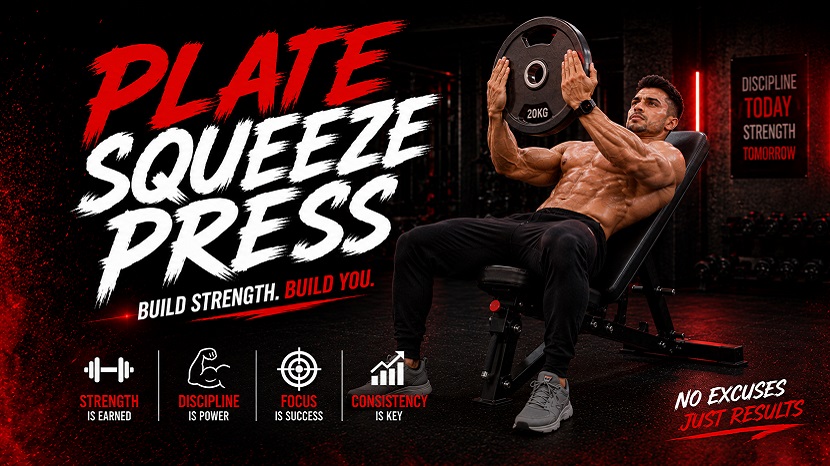
The plate squeeze press stands out as one of the most effective yet underused movements for building a fuller, more defined chest. While traditional bench presses and flyes build overall chest mass, they often leave the inner chest fibers under-stimulated. The plate squeeze press, also widely known as the plate pinch press or svend press, solves this problem by forcing constant tension and a powerful squeeze across the midline of the chest.
This simple exercise requires minimal equipment—just two weight plates—and delivers an intense mind-muscle connection that many lifters struggle to achieve with standard movements. Whether you train at home, in a commercial gym, or while traveling, the plate squeeze press fits easily into any inner chest workout routine. It serves as an excellent finisher after heavier compound lifts and helps create the coveted chest separation and depth that defines a well-developed upper body.
Contents Overview
- What Is the Plate Squeeze Press?
- Key Benefits of the Plate Squeeze Press
- Muscles Worked During Plate Squeeze Press
- How to Do the Plate Squeeze Press: Step-by-Step Guide
- Proper Form and Technique Tips
- Common Mistakes to Avoid
- Effective Variations Including Plate Prayer Press
- Sets, Reps, and Programming Recommendations
- Plate Squeeze Press vs Other Chest Exercises Comparison
- Sample Push Day Workout Including Plate Squeeze Press
- Tips to Maximize Results from Your Inner Chest Workout
- Conclusion
- FAQs
What Is the Plate Squeeze Press?
The plate squeeze press is an isolation-style chest exercise where you hold two weight plates together between your palms and press them away from your body while maintaining constant pressure. The isometric squeeze required to keep the plates from slipping creates continuous tension on the inner pectoral fibers throughout every repetition.
Originally popularized as the svend press, this movement has gained popularity among bodybuilders and fitness enthusiasts searching for best inner chest exercises. Unlike a standard dumbbell or barbell press, where your hands remain fixed on separate implements, the plate squeeze press demands active adduction of the arms the entire time. This unique demand makes it one of the most effective inner chest exercises available with minimal equipment.
Many people looking up how to do plate pinch press discover that the exercise also improves shoulder stability, core engagement, and overall pressing power when performed correctly.
Key Benefits of the Plate Squeeze Press
Adding the plate squeeze press to your routine offers several distinct advantages:
- Superior inner chest activation — The constant squeeze targets the sternal (inner) portion of the pectoralis major more effectively than most pressing movements.
- Enhanced mind-muscle connection — You feel every fiber working, which helps improve overall chest development over time.
- Minimal equipment required — Two light plates are enough, making it perfect for home gyms or busy facilities.
- Joint-friendly option — Lower loads and controlled motion reduce stress on shoulders and elbows compared to heavy bench pressing.
- Excellent pump and metabolic stress — Higher-rep sets create a deep burn that supports hypertrophy and muscle definition.
- Versatile finisher — It complements heavy compounds without adding excessive fatigue to the central nervous system.
- Improved chest aesthetics — Regular use contributes to better chest separation and a more three-dimensional appearance.
Fitness experts frequently recommend the plate squeeze press as one of the best inner chest exercises because it addresses a common weak point in most lifters’ chest development.
Muscles Worked During Plate Squeeze Press
The plate squeeze press primarily targets the chest while recruiting supporting muscles for stability and control.
Primary muscles:
- Pectoralis major (especially the inner and lower fibers)
Secondary muscles:
- Anterior deltoids (front shoulders) — kept minimal with proper form
- Triceps (lateral head mainly)
- Forearms and grip muscles (for maintaining the squeeze)
- Core muscles (for torso stability)
The exercise emphasizes horizontal shoulder adduction under constant tension, which explains why it feels so effective for the inner chest compared to traditional presses.
How to Do the Plate Squeeze Press: Step-by-Step Guide
Follow these steps for safe and effective execution:
- Step 1: Select two light weight plates of equal size (typically 5–10 lb or 2.5–5 kg each to start).
- Step 2: Stand tall with feet hip-width apart, knees slightly bent, and core braced. Squeeze your shoulder blades back and down.
- Step 3: Hold the plates together between your palms with fingers pointing forward or slightly upward. Press the plates firmly into each other from the very beginning.
- Step 4: Position the plates at upper chest level with elbows tucked close to your sides.
- Step 5: Take a deep breath, then slowly press the plates straight forward until your arms are nearly fully extended while maintaining maximum squeeze.
- Step 6: Pause briefly at the end position and squeeze your chest even harder.
- Step 7: Slowly return the plates to the starting position under control, never letting the plates separate.
- Step 8: Exhale as you complete the pressing phase and repeat for the desired number of repetitions.
This controlled tempo ensures continuous tension and maximizes the benefits for your inner chest workout.
Proper Form and Technique Tips
- Always prioritize the squeeze over heavy weight. Light plates allow better control and deeper muscle engagement.
- Keep your shoulders retracted and depressed throughout the set to protect your joints and increase chest involvement.
- Maintain a neutral wrist position and avoid letting the plates tilt or slip.
- Move slowly—especially on the return phase—to increase time under tension.
- Brace your core and glutes to prevent your lower back from arching.
- Focus your mind on crushing the plates together rather than simply moving weight.
Mastering these cues turns the plate squeeze press into one of the most productive movements in your inner chest exercises arsenal.
Common Mistakes to Avoid
Even experienced lifters make errors that reduce effectiveness or increase injury risk:
- Using plates that are too heavy, which causes slipping and breaks the constant tension.
- Allowing the plates to separate during the movement, which eliminates the key isometric squeeze.
- Flaring the elbows outward instead of keeping them tucked.
- Using momentum or bouncing at the bottom instead of controlled movement.
- Neglecting core engagement, leading to instability and poor posture.
- Shortening the range of motion by not fully extending the arms or not returning fully to the chest.
- Holding breath instead of breathing rhythmically, which reduces performance and safety.
Correcting these mistakes ensures you get maximum value from every set of plate press chest work.
Effective Variations Including Plate Prayer Press
Once you master the basic movement, try these progressions and variations:
- Standing Plate Squeeze Press — The standard version described above, ideal for overall inner chest activation.
- Incline Plate Squeeze Press — Perform on an incline bench to emphasize the upper inner chest fibers.
- Lying Plate Squeeze Press — Lie on a flat bench for greater stability and isolated chest focus.
- Plate Prayer Press — A popular variation where you move the squeezed plates in an arc (up and down or in small circles) while maintaining pressure. This adds variety and extra burn to your inner chest workout.
- Single Plate Version — Use one heavier plate held horizontally with both hands for a slightly different stimulus when two plates are unavailable.
- Seated Version — Sit on a bench or chair for added back support, helpful for beginners or those with lower back concerns.
These options allow you to target different angles and keep your best inner chest exercises routine fresh and challenging.
Sets, Reps, and Programming Recommendations
The plate squeeze press works best with higher repetitions and moderate to short rest periods because the goal is muscle pump and metabolic stress rather than maximal strength.
Recommended guidelines:
- For muscle growth: 3–4 sets of 10–15 controlled repetitions.
- As a finisher: 3–5 sets of 15–20+ repetitions with minimal rest between sets.
- Warm-up sets: 1–2 lighter sets of 12–15 reps before heavier chest work.
Perform the exercise toward the end of your chest or push session after compound movements like bench press and incline press. This placement allows you to pre-fatigue the chest and then finish it with the intense squeeze of the plate squeeze press.
Plate Squeeze Press vs Other Chest Exercises Comparison
| Exercise | Primary Focus | Constant Squeeze | Equipment Needed | Best Used As | Joint Stress Level |
|---|---|---|---|---|---|
| Plate Squeeze Press | Inner chest isolation | Very High | 2 light plates | Finisher | Low |
| Barbell Bench Press | Overall chest mass | Low | Barbell and bench | Main strength lift | Moderate |
| Dumbbell Squeeze Press | Inner chest + triceps | High | Dumbbells | Accessory | Low to Moderate |
| Cable Crossover | Inner chest with stretch | High at peak | Cable machine | Pump movement | Low |
| Dumbbell Flye | Chest stretch and squeeze | Moderate | Dumbbells | Accessory | Moderate |
This comparison shows why the plate squeeze press earns its place among the best inner chest exercises—it delivers unmatched constant tension with very low equipment and joint demands.
Sample Push Day Workout Including Plate Squeeze Press
| Exercise | Sets | Reps | Rest | Notes |
|---|---|---|---|---|
| Barbell Bench Press | 4 | 6–8 | 2 min | Heavy compound movement |
| Incline Dumbbell Press | 3 | 8–12 | 90 sec | Upper chest focus |
| Overhead Shoulder Press | 3 | 8–12 | 90 sec | Deltoid and tricep development |
| Plate Squeeze Press | 3 | 15–20 | 60 sec | Inner chest finisher, max squeeze |
| Tricep Rope Pushdown | 3 | 12–15 | 60 sec | Tricep isolation |
Perform this routine once or twice per week, adjusting volume based on recovery and goals. The plate squeeze press placed near the end ensures your chest receives complete stimulation.
Tips to Maximize Results from Your Inner Chest Workout
- Always warm up thoroughly with light sets and dynamic shoulder movements.
- Progress by increasing repetitions, slowing the tempo, or adding brief pauses at full extension before adding heavier plates.
- Pair the exercise with proper nutrition that supports muscle growth, including adequate protein intake.
- Take progress photos every 4–6 weeks to track improvements in chest definition.
- Combine with other inner chest exercises such as cable crossovers or hex presses for well-rounded development.
- Listen to your body—if shoulder discomfort occurs, reduce range or lighten the load and consult a professional if pain persists.
- Stay consistent. The plate squeeze press delivers the best results when performed regularly over months, not just occasional sessions.
Conclusion
The plate squeeze press (also called plate pinch press or svend press) deserves a permanent spot in any serious inner chest workout. Its ability to create constant tension and an intense squeeze makes it one of the best inner chest exercises for building definition, improving mind-muscle connection, and achieving balanced chest development.
Whether you are a beginner learning how to do plate pinch press or an advanced lifter seeking new ways to finish chest sessions, this movement offers simplicity, effectiveness, and versatility. Incorporate the plate squeeze press or its variations like the plate prayer press consistently, focus on quality form, and pair it with smart programming. Over time, you will notice improved chest fullness, better separation, and stronger pressing performance across all your lifts.
Start with light plates today, prioritize the squeeze, and experience why so many dedicated lifters consider the plate squeeze press an essential tool for complete chest development. Your inner chest will thank you.
Frequently Asked Questions (FAQs)
1. What is the plate squeeze press exercise?
Answer: The plate squeeze press is a chest isolation exercise performed by pressing two weight plates together in front of your body while extending your arms forward. It combines a pressing motion with continuous inward pressure, creating constant tension on the chest muscles throughout the entire range of motion.
2. What muscles does the plate squeeze press work?
Answer: The plate squeeze press primarily targets the pectoralis major, with strong emphasis on the inner and sternal fibers of the chest due to the squeezing action. It also engages the anterior deltoids and triceps as secondary movers, while the core and upper back muscles work to stabilize your posture during the movement.
3. How do you do the plate squeeze press with correct form?
Answer: Stand with feet shoulder-width apart. Hold two equal-weight plates (smooth sides facing each other) by gripping the edges firmly with both hands at chest level. Squeeze the plates together as hard as possible. While maintaining the squeeze, slowly extend your arms straight forward until fully extended. Pause for one second, then slowly return the plates to the starting position at your chest without losing tension. Keep shoulders down and back, elbows slightly soft, and avoid arching your lower back.
4. What are the key benefits of the plate squeeze press?
Answer: This exercise builds thickness and definition in the inner chest, strengthens the mind-muscle connection, delivers constant tension without heavy joint stress, and serves as an excellent finisher after compound chest movements. It also improves overall pectoral activation and can enhance performance in other pressing exercises.
5. Is the plate squeeze press suitable for beginners?
Answer: Yes, the plate squeeze press is beginner-friendly when started with light plates. Use 5 to 10 pound plates to master the squeeze technique and body positioning first. Perform 2 to 3 sets of 10 to 15 controlled repetitions. Focus on feeling the chest contraction rather than lifting heavy weight. Progress gradually as form improves.
6. What equipment is required for the plate squeeze press?
Answer: You only need two weight plates of the same size and weight. Standard 5 lb, 10 lb, or 25 lb plates work well. The exercise requires no bench, cables, or machines, making it easy to perform at home or in any open gym space with enough room to extend your arms.
7. How many sets and reps should you perform?
Answer: For best results, perform 3 to 4 sets of 12 to 20 repetitions. Higher rep ranges work well because the exercise emphasizes muscle squeeze and time under tension rather than maximal load. Rest 60 to 90 seconds between sets. Use it as a finisher after heavier compound lifts such as bench press or incline press.
8. What are the most common mistakes in the plate squeeze press?
Answer: Common mistakes include failing to maintain a strong continuous squeeze on the plates, using momentum or swinging the body, choosing plates that are too heavy and breaking form, locking out the elbows completely, flaring the elbows excessively, shrugging the shoulders, and rushing the return phase instead of controlling it slowly.
9. What variations can you try for the plate squeeze press?
Answer: Effective variations include the incline plate squeeze press (performed on an incline bench to target the upper chest), seated plate squeeze press, floor plate squeeze press for a shorter range of motion, single-arm plate squeeze press for unilateral work, and tempo variations with slow eccentrics or isometric holds at full arm extension. You can also perform it on a stability ball to increase core engagement.
10. How do you progress the plate squeeze press for advanced gains?
Answer: Advanced lifters can progress by using heavier plates while maintaining perfect form, adding 3 to 5 second pauses at full arm extension, slowing the lowering phase to 4 seconds per rep, performing drop sets, or supersetting with push-ups or cable flyes. Another option is to combine it with partial reps or perform it on an unstable surface to further challenge stability and core strength.