Contents Overview
- What Is the Cable Fly Exercise?
- Muscles Worked During the Cable Fly Exercise
- Top Cable Fly Benefits for Chest Development
- How to Do Cable Fly: Step by Step Instructions
- Essential Cable Fly Form and Technique Tips
- Common Cable Fly Mistakes and How to Correct Them
- Popular Cable Fly Variations to Target Different Chest Areas
- Cable Fly vs Dumbbell Fly: Which Builds Better Chest Muscle?
- Sample Chest Workout Routine Featuring Cable Fly
- Beginner and Advanced Tips for Cable Fly Success
- Safety Considerations and Modifications for Cable Fly
- Final Thoughts
- FAQs
What Is the Cable Fly Exercise?
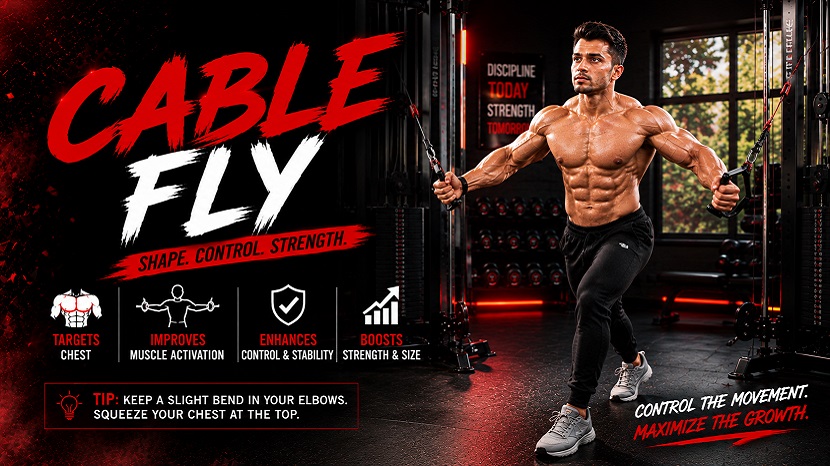
The cable fly exercise stands out as a premier isolation movement designed to sculpt and strengthen the chest. Performed on a cable machine, it involves bringing the arms together in a wide, controlled arc that mimics hugging a large object. This creates continuous tension on the pectoral muscles throughout the entire range of motion, unlike many free-weight movements where resistance drops at certain points.
People searching for how to do cable fly often want a focused way to add shape and definition without relying solely on heavy pressing. The cable chest fly can be done in a standing cable fly position or seated for more stability. It is frequently called a cable crossover when the hands cross at the midline, delivering an intense peak contraction in the inner chest.
This exercise has become a staple in modern chest training programs because it emphasizes mind-muscle connection and controlled movement. Whether you are a beginner learning proper technique or an experienced lifter seeking new stimulus, mastering the cable fly exercise can transform your upper body development.
Muscles Worked During the Cable Fly Exercise
The primary muscle targeted by the cable fly exercise is the pectoralis major. This large fan-shaped muscle covers the upper chest and consists of different fiber orientations that respond well to varying cable angles.
The clavicular (upper) head receives extra emphasis during low to high cable fly movements, while the sternal and abdominal (lower) heads work harder during high to low cable fly variations. The anterior deltoids assist as secondary movers, helping guide the arms through the arc.
Smaller stabilizer muscles also play important roles. The serratus anterior helps protract the shoulder blades, while the core muscles, including the obliques and transverse abdominis, engage to maintain an upright posture during standing cable fly sets. The biceps and triceps act as stabilizers to keep the elbows in a slightly bent position throughout the movement.
Because the cables provide constant resistance, the entire chest stays under tension from the start of the rep to the finish. This sustained engagement promotes better muscle fiber recruitment compared to exercises where gravity reduces the load at the top or bottom of the motion.
Top Cable Fly Benefits for Chest Development
Understanding the cable fly benefits helps explain why this movement deserves a regular place in chest workouts. One of the biggest advantages is the constant tension provided by the cable system. This keeps the pectoralis major working hard during both the concentric and eccentric phases, which supports muscle hypertrophy through increased time under tension and metabolic stress.
The cable fly exercise also improves mind-muscle connection. Many lifters report feeling the chest working more directly than during pressing movements. This focused activation can lead to better muscle growth and improved chest definition over time.
Another key benefit is joint-friendly loading. Because you can use lighter weights with strict form, the exercise places less stress on the shoulders and elbows compared to heavy bench pressing. It serves as an excellent finisher after compound lifts to fully fatigue the chest without excessive fatigue on the joints.
The versatility of cable fly variations allows targeted training. Adjusting pulley height lets you emphasize the upper, middle, or lower chest as needed. Single-arm versions help correct muscle imbalances, while seated setups reduce lower back involvement for those who need extra stability.
Finally, the cable fly exercise enhances overall pressing strength. A stronger, more developed chest from isolation work often translates to better performance on bench press and other compound movements.
How to Do Cable Fly: Step by Step Instructions
Learning how to do cable fly correctly starts with proper machine setup. Position the pulleys at approximately chest height for a standard mid-chest emphasis. Attach D-handles or stirrup handles to each cable.
Stand in the center of the cable machine with one foot slightly in front of the other for balance. Grasp the handles and take one small step forward so the weight stack lifts slightly and tension is already present before you begin the movement.
Keep a slight bend in your elbows throughout the entire set. Do not lock the joints or allow them to straighten completely. Maintain a tall posture with your chest lifted and shoulders relaxed away from your ears.
Begin the movement by bringing your arms forward and slightly downward in a wide arc, as if you are wrapping your arms around a large barrel. Focus on squeezing your chest muscles as your hands come together in front of your body.
Pause for one to two seconds at the point of maximum contraction and consciously squeeze the pectoral muscles. Then slowly reverse the motion, controlling the handles as they return to the starting position. Resist the urge to let the cables pull your arms back quickly.
Complete the desired number of repetitions while maintaining the same controlled tempo on every rep. Breathe out during the forward motion and inhale during the return phase.
Essential Cable Fly Form and Technique Tips
Mastering cable fly form separates average results from exceptional chest development. Always prioritize control over weight. Using too much resistance turns the exercise into a pressing movement and reduces chest activation.
Keep the elbows slightly bent and fixed in that position. Straightening the arms shifts stress to the shoulder joints and reduces the isolation effect on the chest. Think of your arms as hooks that simply connect the cables to your chest muscles.
Use the barrel-hugging cue to guide your path. This mental image helps maintain the correct arc and prevents the arms from moving in a straight line, which would resemble a press rather than a fly.
Control the eccentric portion of every repetition. The return phase should take at least as long as the forward motion. This slow negative increases time under tension and promotes greater muscle damage and subsequent growth.
Maintain a neutral spine and engaged core. Avoid arching your lower back or leaning too far forward, as these compensations reduce chest involvement and can strain the back. Keep your head in a neutral position and look straight ahead.
Focus on quality over quantity. It is better to perform eight perfect repetitions than fifteen sloppy ones. Quality reps build better muscle and reduce injury risk.
Common Cable Fly Mistakes and How to Correct Them
Even experienced lifters sometimes make errors when performing the cable fly exercise. One frequent mistake is selecting weights that are too heavy. This forces the use of momentum and turns the movement into a partial press. Solution: reduce the weight until you can complete every rep with strict form and a full range of motion.
Another common issue involves the shoulders rolling forward during the set. This shifts tension away from the chest and onto the front deltoids. Keep your shoulder blades retracted and down throughout the movement to maintain chest dominance.
Rushing through repetitions with fast, bouncy movements eliminates the benefits of constant tension. Slow down both the positive and negative phases. Aim for a two-second concentric and three-second eccentric tempo to maximize muscle engagement.
Incomplete range of motion is another problem. Many people stop short of bringing the hands together or fail to stretch the chest fully on the return. Always work through a complete, pain-free range to fully stimulate all portions of the pectoralis major.
Finally, some lifters shrug their shoulders toward their ears. This unnecessary tension reduces chest activation and can lead to neck discomfort. Consciously relax the trapezius muscles before each set and maintain that relaxation throughout.
Popular Cable Fly Variations to Target Different Chest Areas
Exploring cable fly variations allows you to emphasize specific regions of the chest for balanced development. The low to high cable fly places the pulleys near the floor or lowest setting. You pull the cables upward and inward, which targets the upper chest fibers more effectively. This variation is excellent for filling out the top of the pectoralis major.
The high to low cable fly positions the pulleys above shoulder height. You pull downward and across the body, shifting emphasis to the lower and middle chest. Leaning slightly forward during this variation can increase lower chest activation for a more rounded appearance.
Single-arm cable chest fly variations help address strength imbalances between sides. Perform all repetitions on one side before switching, or alternate arms for continuous tension. This unilateral approach also improves core stability and mind-muscle connection.
Seated cable fly setups provide additional back support, making them ideal for beginners or individuals with lower back concerns. The fixed position reduces the need for balance and allows greater focus on the chest contraction.
Other creative options include incline or decline bench cable flies when the machine setup allows, and floor cable flies performed while lying on the ground. Each variation slightly changes the angle of pull and muscle recruitment pattern, keeping training fresh and effective.
Cable Fly vs Dumbbell Fly: Which Builds Better Chest Muscle?
Many people compare the cable fly exercise with the dumbbell fly when designing chest routines. Both are isolation movements, yet they offer different advantages.
| Aspect | Cable Fly | Dumbbell Fly |
|---|---|---|
| Tension Profile | Constant tension throughout entire range of motion | Variable tension; decreases at top of movement |
| Peak Contraction | Excellent squeeze possible at midline | Good but limited by gravity at top |
| Stretch at Bottom | Moderate stretch; depends on starting position | Deeper stretch possible at bottom position |
| Joint Stress | Generally lower when form is strict | Higher if elbows lock or weights are dropped |
| Best For | Hypertrophy, definition, constant tension | Deep stretch, coordination, and stability |
| Equipment Needed | Cable machine | Pair of dumbbells and bench |
The cable fly exercise excels when the goal is sustained tension and a strong peak contraction. The dumbbell fly may provide a superior stretch at the bottom of the movement. Most effective programs include both exercises at different times rather than choosing one exclusively.
Sample Chest Workout Routine Featuring Cable Fly
Here is a balanced chest workout that incorporates the cable fly exercise as a key isolation movement. Perform this routine once or twice per week with at least 48 hours of recovery between sessions.
- Barbell or Dumbbell Bench Press — 4 sets of 6-8 reps (compound strength builder)
- Incline Dumbbell Press — 3 sets of 8-10 reps (upper chest emphasis)
- Standing Cable Fly or High to Low Cable Fly — 3 sets of 12-15 reps (constant tension finisher)
- Low to High Cable Fly — 3 sets of 12-15 reps (upper chest detail work)
- Push-Ups or Machine Chest Press — 2 sets to near failure (metabolic finish)
Rest 60-90 seconds between sets for isolation movements and 2-3 minutes for compound presses. Focus on progressive overload by gradually increasing weight or improving form over time. Always warm up thoroughly with light sets and dynamic shoulder mobility work before beginning the working sets.
Beginner and Advanced Tips for Cable Fly Success
Beginners should start with very light weight to master cable fly form before adding resistance. Focus on feeling the chest muscles working rather than moving heavy loads. Film your sets from the side to check elbow position and range of motion.
Intermediate lifters can experiment with tempo techniques such as 3-second negatives or 1.5 reps (full rep plus a half rep at the bottom) to increase intensity without adding weight.
Advanced trainees often use drop sets or rest-pause techniques on the final set of cable chest fly variations to push past plateaus. Pairing cable fly variations with blood flow restriction training can also create an intense pump when appropriate.
Regardless of experience level, track your workouts and aim for gradual improvement in either weight used, reps completed, or perceived muscle activation. Consistency with proper form produces the best long-term results.
Safety Considerations and Modifications for Cable Fly
The cable fly exercise is generally safe when performed correctly, but certain precautions help prevent injury. Always inspect the cable machine and attachments before use to ensure cables are not frayed and pulleys move smoothly.
Individuals with existing shoulder impingement or rotator cuff issues should consult a qualified professional before attempting fly movements. Modifications such as reducing range of motion or using a neutral grip may be appropriate depending on the specific condition.
Never sacrifice form for heavier weight. If you feel pain (as opposed to normal muscle fatigue) in the shoulders or elbows, stop immediately and reassess your setup and technique. Keep the movement pain-free and within a comfortable range of motion.
Stay hydrated and maintain good overall recovery practices, including adequate sleep and protein intake, to support muscle repair and growth from your chest training sessions.
Final Thoughts
The cable fly exercise offers a unique combination of constant tension, excellent mind-muscle connection, and targeted chest development that few other movements can match. Whether you choose the standard standing cable fly, low to high cable fly for upper chest emphasis, or high to low cable fly for lower chest detail, this exercise delivers results when performed with proper cable fly form.
By understanding the cable fly benefits, avoiding common mistakes, and exploring smart cable fly variations, you can build a thicker, more defined chest while supporting overall upper body strength. Combine the movement with solid compound lifts, progressive overload, and good recovery habits for the best outcomes.
Start incorporating the cable fly exercise into your next chest session and experience the difference that focused, constant-tension isolation work can make. With patience and attention to detail, you will see noticeable improvements in both strength and appearance.
Frequently Asked Questions (FAQs)
1. What is the cable fly exercise?
Answer: The cable fly is an isolation exercise performed on a cable crossover machine. It involves standing between two cable pulleys and pulling the handles together in front of your body in a wide, hugging arc motion. Unlike pressing movements such as the bench press, the cable fly focuses on stretching and squeezing the chest muscles through a long range of motion while cables provide constant tension throughout the entire movement.
2. What muscles does the cable fly primarily target?
Answer: The cable fly mainly targets the pectoralis major, with strong emphasis on the inner and lower portions of the chest. It also engages the front shoulders (anterior deltoids) as stabilizers and works the core and arms to a lesser degree. This exercise is excellent for developing chest width, muscle separation, and that full, rounded appearance in the pectoral muscles.
3. How do you perform the cable fly with proper form?
Answer: Set the cable pulleys at shoulder height or slightly above. Stand in the center of the machine with one foot slightly forward for balance and grasp one handle in each hand. Keep a soft bend in your elbows, then slowly bring your hands together in a wide arc in front of your chest while squeezing your chest muscles hard at the peak. Control the return as your arms open wide again without letting your shoulders roll forward or your back arch. Always keep your core tight and maintain an upright posture throughout the movement.
4. What are the key benefits of adding cable fly to your chest workouts?
Answer: Cable fly provides constant tension on the chest muscles from start to finish, which supports better muscle growth and definition. It is especially effective for targeting the inner chest and creating visible separation between the pectoral muscles. The exercise also improves mind-muscle connection, allows a deep stretch, and places less stress on the shoulder joints compared to heavy pressing movements when performed with good form.
5. What common mistakes should you avoid during cable fly?
Answer: Avoid using momentum or swinging your body to move the weight, as this reduces chest activation and increases injury risk. Do not fully lock out your elbows at any point, since this can strain the joints. Keep the movement at mid-chest level instead of letting your arms drop too low or rise too high. Always control the return phase slowly rather than letting the cables pull your arms back quickly, and maintain good posture without rounding your shoulders or arching your lower back.
6. How does cable fly compare to dumbbell fly or pec deck machine?
Answer: Cable fly maintains constant tension even at the bottom of the movement, offering a superior stretch compared to dumbbell fly where tension decreases. Dumbbell fly allows a more natural arm path but requires greater stabilizer muscle involvement. The pec deck machine provides a fixed path and is often easier for complete beginners. Most experienced lifters include cable fly for better inner chest development while using all three variations across their training program for complete chest development.
7. Is the cable fly suitable for beginners?
Answer: Yes, the cable fly is beginner-friendly when you start with light weight and focus on learning proper form. It helps new lifters develop a strong mind-muscle connection and feel their chest working effectively. Beginners should perform cable fly after their main compound exercises such as bench press. Start with 2 to 3 sets of 12 to 15 controlled repetitions to build confidence and strength safely before increasing weight.
8. What is the ideal number of sets and reps for cable fly?
Answer: For muscle growth and chest development, perform 3 to 4 sets of 10 to 15 repetitions. Choose a weight that challenges you on the final 2 to 3 reps while allowing you to maintain perfect form throughout. Rest 60 to 90 seconds between sets. You can include cable fly 2 to 3 times per week as part of your chest or push workout, making sure to allow at least 48 hours of recovery between sessions targeting the same muscle group.
9. What are some effective variations of the cable fly exercise?
Answer: High-to-low cable fly emphasizes the lower chest, while low-to-high cable fly targets the upper chest more effectively. Single-arm cable fly helps correct strength imbalances between the left and right sides. You can also try seated cable fly for added stability or add a slight forward lean to increase the stretch. Crossing your hands slightly at the peak contraction provides an extra squeeze on the inner chest fibers.
10. How can advanced lifters make cable fly more challenging?
Answer: Advanced lifters can slow the lowering (eccentric) phase to 3 or 4 seconds to increase time under tension. Perform drop sets by reducing the weight after reaching failure and continuing without rest. Try supersets by pairing cable fly immediately with push-ups or bench press. Unilateral (one-arm) work and adding a 1-2 second pause at the point of maximum chest contraction are also effective ways to further stimulate muscle growth and overcome plateaus.