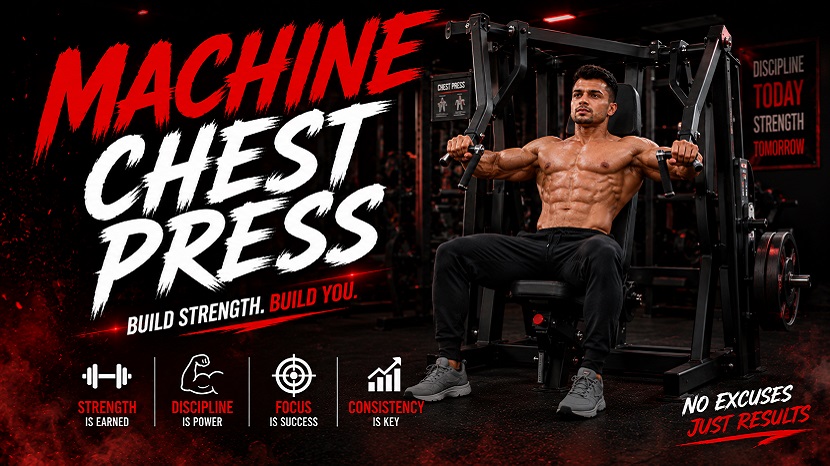
If you want to build a bigger and stronger chest, the machine chest press is one of the most effective and beginner-friendly exercises available in most gyms. The chest press machine provides built-in stability that lets you focus entirely on your target muscles without the balance challenges of free weights.
Whether you are just starting out or looking to add smart volume to your training, understanding the seated chest press machine can transform your results. This guide covers how to do machine chest press with perfect machine chest press form, the real machine chest press benefits, a clear machine chest press vs bench press comparison, the chest press machine muscles worked, and exactly how to fit it into a productive chest press machine workout.
Contents Overview
- What is the Machine Chest Press Exercise?
- Chest Press Machine Muscles Worked
- Top Machine Chest Press Benefits
- How to Do Machine Chest Press with Correct Form
- Common Mistakes in Machine Chest Press Form
- Machine Chest Press vs Bench Press: Which One to Choose?
- Variations for Your Seated Chest Press Machine
- Recommended Sets, Reps, and Progression
- Safety Tips for Proper Machine Chest Press Technique
- Sample Chest Workout with Machine Chest Press
- Final Thoughts on Incorporating Machine Chest Press
- FAQs
What is the Machine Chest Press Exercise?
The machine chest press is a resistance exercise performed on a guided gym machine that simulates a horizontal pushing movement. You sit on a padded seat, grip two handles positioned at chest level, and push them forward until your arms are nearly straight before returning them slowly under control.
Unlike barbell or dumbbell presses, the chest press machine uses a fixed path of motion. This design removes the need to balance the weight in multiple directions, allowing you to direct more effort toward the chest itself. The exercise is available in both selectorized weight-stack versions and plate-loaded models in most commercial gyms.
Many lifters include the seated chest press machine in their routines because it supports safe progression, reduces the requirement for a spotter, and works well as either a primary movement or a high-quality accessory exercise after heavier free-weight work.
Chest Press Machine Muscles Worked
Knowing the chest press machine muscles worked helps you train with better intention and get more from every rep. The primary muscle is the pectoralis major, the large fan-shaped muscle covering most of your chest. Both the upper (clavicular) and mid-to-lower (sternal) portions contribute to the pressing and inward-pulling action.
The front shoulders, known as the anterior deltoids, assist throughout the movement, particularly near the top of the press. The triceps brachii on the back of your upper arms provide the force needed to straighten the elbows and complete each repetition.
Supporting muscles include the serratus anterior, which stabilizes the shoulder blades against the back pad, and the core muscles that keep your torso upright. By focusing on a strong chest squeeze at the top of every rep, you can improve mind-muscle connection and drive better growth in the target area.
Top Machine Chest Press Benefits
The machine chest press benefits make this exercise valuable for lifters at every level. One major advantage is built-in stability. Because the machine guides the movement, you can concentrate fully on pressing with your chest instead of worrying about balancing the load.
Another key benefit is constant tension across the full range of motion. Many machines maintain resistance even at the top position, unlike free weights where tension can decrease. This sustained load supports muscle growth effectively.
The exercise is often more joint-friendly for people with shoulder concerns when the seat and handles are adjusted correctly. It also allows safe training close to muscular failure without needing a spotter, which is helpful for both beginners and advanced trainees pushing their limits.
Additional machine chest press benefits include easier isolation of the chest after compound lifts, reduced stabilizer fatigue, and the ability to accumulate extra training volume safely. These qualities explain why the movement remains popular in well-designed chest programs.
How to Do Machine Chest Press with Correct Form
Learning how to do machine chest press correctly protects your joints and maximizes chest development. Follow these steps for solid machine chest press form.
- Adjust the seat so the handles align with the middle of your chest when seated. Your feet should rest flat on the floor with your knees bent at roughly 90 degrees.
- Sit tall and press your entire back firmly against the back pad. Avoid rounding your shoulders or creating an excessive arch in your lower back.
- Grip the handles with a comfortable overhand position. Keep your wrists straight and aligned with your forearms throughout the set.
- Brace your core, take a deep breath, and press the handles forward in a smooth, controlled motion. Focus on driving your elbows toward each other as you push.
- Exhale during the hardest part of the press. Stop just short of locking your elbows to keep tension on the chest muscles.
- Pause for one second at the top and consciously squeeze your chest before starting the return phase.
- Lower the handles slowly over two to three seconds to emphasize the eccentric portion of the lift, which is highly effective for muscle growth.
- Repeat for your target reps while maintaining the same posture and control on every repetition.
Always begin with a light weight to groove the pattern before increasing the load. Quality movement matters more than heavy numbers when you are learning how to do machine chest press.
Common Mistakes in Machine Chest Press Form
Even on a stable machine, small errors can limit results or increase injury risk. Here are frequent problems and simple fixes for better machine chest press form.
- Using too much weight often leads to shrugging the shoulders or using momentum. Reduce the load until you can complete every rep with strict control and a strong chest squeeze.
- Flaring the elbows out wide at 90 degrees or more places extra stress on the shoulders. Keep elbows at roughly 45 degrees from your torso for better chest targeting and joint safety.
- Arching the lower back excessively reduces chest involvement and strains the spine. Stay pressed flat against the pad and keep your core braced throughout the set.
- Using only partial range of motion cheats the stretch and the peak contraction. Move through a full, comfortable range that you can control on both the press and the return.
- Shrugging the shoulders upward shifts work away from the chest and onto the upper traps. Keep your shoulders down and back for the entire set.
- Rushing the lowering phase misses a major growth opportunity. Slow the eccentric portion deliberately to increase time under tension.
Correcting these issues will make every set on the chest press machine more productive and safer.
Machine Chest Press vs Bench Press: Which One to Choose?
When comparing machine chest press vs bench press, the best choice depends on your experience, goals, and current physical condition. The barbell or dumbbell bench press builds overall pressing strength and requires significant work from stabilizer muscles in the shoulders, upper back, and core. It transfers well to sports and daily activities but carries a higher technical demand and injury risk when form breaks down under heavy loads.
The machine chest press provides a fixed path that allows greater isolation of the chest and safer training close to failure. It is often easier for beginners to learn and more joint-friendly for those returning from minor shoulder issues. You can usually handle more weight or perform more clean repetitions because stability is supplied by the machine.
Most effective programs use both movements. Free-weight presses build foundational strength while the chest press machine adds valuable isolation volume without excessive fatigue to the stabilizers. If you are new to lifting or have shoulder limitations, prioritize the seated chest press machine first and gradually introduce bench press variations as your form and confidence improve.
| Aspect | Machine Chest Press | Bench Press |
|---|---|---|
| Stability | High – machine provides fixed path | Low to moderate – requires balance and control |
| Chest Isolation | Excellent – less stabilizer demand | Good but shared with stabilizers |
| Beginner Friendliness | Very high – easier to learn safely | Moderate – requires coaching and practice |
| Joint Stress | Generally lower when set up correctly | Higher if form or mobility is poor |
| Best For | Hypertrophy, volume, safe failure training | Overall strength, athletic transfer, heavy loading |
Variations for Your Seated Chest Press Machine
You can modify the seated chest press machine to emphasize different parts of the chest or address weaknesses. On machines with converging handles, the inward movement at the top increases inner-chest contraction.
Slight changes in torso angle also work well. Leaning the upper body slightly forward on some machines shifts emphasis toward the upper chest fibers. Sitting more upright or with a small backward lean can target the lower chest more directly.
Changing grip width offers another option. A slightly narrower grip increases triceps involvement while a wider grip stresses the outer chest. If your machine allows single-arm work, performing one side at a time helps correct left-to-right strength imbalances.
Experiment with these variations across different chest press machine workout sessions to keep training stimulating and ensure balanced chest development.
Recommended Sets, Reps, and Progression
For muscle growth, most people respond well to 3 or 4 sets of 8 to 12 repetitions on the machine chest press. This range creates a good balance of mechanical tension and metabolic stress that supports hypertrophy.
If your primary goal is strength, use heavier loads for 4 to 6 reps per set. Beginners or those focusing on endurance can benefit from 12 to 15 controlled reps. Rest 60 to 90 seconds between sets when training for size.
Progressive overload remains essential. Each week aim to add a small amount of weight, complete one extra clean repetition, or improve your mind-muscle connection and control. Keep a simple training log so you can track progress over time and continue making steady gains.
Safety Tips for Proper Machine Chest Press Technique
Following proper machine chest press technique protects your shoulders, elbows, and lower back. Always inspect the machine before use. Confirm the weight pin is fully inserted and the handles move smoothly without catching.
Warm up your chest, shoulders, and elbows with one or two light sets before adding working weight. Never fully lock your elbows at the top of the movement; maintain a soft bend to protect the joint.
Breathe naturally: inhale during the lowering phase and exhale during the press. Avoid holding your breath for long periods. If you experience sharp joint pain rather than normal muscle fatigue, stop the set and reassess your form or load.
Choose a weight you can control through the full range for every repetition. Prioritize perfect technique over ego lifting to stay injury-free and consistent for the long term.
Sample Chest Workout with Machine Chest Press
Here is a balanced chest session that uses the machine chest press as a key accessory movement after heavier compound work.
- Barbell or Dumbbell Bench Press – 4 sets of 6 to 8 reps for foundational strength
- Incline Dumbbell Press – 3 sets of 8 to 10 reps to target the upper chest
- Machine Chest Press – 3 sets of 10 to 12 reps for isolation and extra volume
- Dumbbell Chest Flyes or Cable Crossovers – 3 sets of 12 to 15 reps for stretch and peak contraction
- Push-Ups or Chest-Focused Dips – 2 to 3 sets to near failure as a finisher
Perform this routine once or twice per week with at least 48 hours of recovery between chest sessions. Pair chest training with back work for balanced upper-body development. Adjust weights and repetitions according to your current fitness level and how well you recover.
Final Thoughts on Incorporating Machine Chest Press
The machine chest press is a versatile, effective, and safe tool for building chest size and strength. Whether you are learning how to do machine chest press for the first time or adding smart volume as an experienced lifter, it earns its place in a well-rounded chest press machine workout.
Focus on quality movement, full range of motion, and a strong mind-muscle connection. Combine the chest press machine with free-weight presses for complete development, progress gradually, and support your training with good nutrition and recovery. Consistent effort with proper machine chest press form will deliver noticeable improvements in chest thickness and pressing power over time.
Frequently Asked Questions (FAQs)
1. What is the Machine Chest Press exercise?
Answer: The Machine Chest Press is a guided strength training exercise performed on a chest press machine. It involves sitting upright and pushing weighted handles or a bar forward in a controlled arc to target the chest. The machine provides a fixed path of motion, making it an effective and stable way to build upper body pushing strength and chest muscle size.
2. Which muscles does the Machine Chest Press primarily target?
Answer: The Machine Chest Press primarily works the pectoralis major, the large muscles of the chest that create width and thickness. It also engages the anterior deltoids at the front of the shoulders and the triceps at the back of the upper arms as secondary movers. The exercise provides excellent isolation for the chest while reducing the demand on core stabilizers compared to free-weight presses.
3. How do you perform the Machine Chest Press with proper form?
Answer: Sit on the machine with your back flat against the pad and feet firmly on the floor. Adjust the seat height so the handles align with the middle of your chest. Grip the handles with palms facing forward and a slight bend in the elbows. Push the handles forward smoothly until your arms are extended without locking the elbows, then slowly return to the starting position while controlling the weight. Keep your core engaged, shoulders down and back, and avoid arching your lower back at any point.
4. What are the key benefits of including Machine Chest Press in your workout?
Answer: The Machine Chest Press offers superior chest isolation, reduced injury risk due to its stable and guided movement path, and accessibility for all fitness levels. It allows you to focus purely on the pressing motion without balancing free weights, making it ideal for building muscle, correcting imbalances, and training safely when training alone. It is also time-efficient and joints-friendly for higher-rep hypertrophy work.
5. Is the Machine Chest Press recommended for beginners?
Answer: Yes, the Machine Chest Press is one of the best chest exercises for beginners. The fixed path and external stability help new lifters learn proper pressing mechanics safely without the balance demands of dumbbells or barbells. Beginners should start with light to moderate weight, focus on controlled reps of 10–15, and prioritize perfect form before increasing load.
6. How does the Machine Chest Press compare to the traditional Bench Press?
Answer: The Machine Chest Press uses a fixed range of motion and machine stability, which reduces the need for stabilizer muscles and lowers injury risk, while the Barbell Bench Press requires greater core and shoulder stabilization and allows heavier loading. The machine version excels at pure chest isolation and is ideal for beginners or solo training, whereas the bench press builds more functional strength and overall power but demands better technique and often a spotter.
7. What are the most common mistakes people make when doing the Machine Chest Press?
Answer: Common mistakes include using momentum or bouncing the weight, locking the elbows forcefully at the top, arching the lower back excessively, and choosing a seat height that misaligns the handles with the chest. Other frequent errors are gripping too wide or narrow, failing to control the return phase, and holding the breath instead of exhaling on the push. These mistakes reduce chest activation and increase joint stress.
8. How can you progress and build strength using the Machine Chest Press?
Answer: Beginners should master form with moderate weights for 10–12 controlled reps. Intermediate lifters can apply progressive overload by gradually increasing weight while keeping strict form. Advanced trainees benefit from techniques such as pause reps at the bottom, slow eccentric tempos, drop sets, or supersetting the machine press with dumbbell flyes or push-ups to continue driving muscle growth and strength gains.
9. How frequently should you perform the Machine Chest Press in your training routine?
Answer: Most people see excellent results performing the Machine Chest Press 1–2 times per week as part of a chest or push-focused workout. Allow at least 48 hours of recovery between sessions that heavily tax the chest. It can serve as a main compound movement early in the workout or as a high-rep finisher later, depending on your overall training split and recovery capacity.
10. What safety tips should you follow when performing the Machine Chest Press?
Answer: Always warm up with 1–2 light sets before adding working weight. Ensure the seat and handles are properly adjusted for your body before starting. Never use weight that forces you to compromise form or use momentum. Keep your shoulders retracted and down, maintain a neutral spine, and avoid full elbow lockout if it causes joint discomfort. Stop immediately if you feel sharp pain and consult a doctor or qualified trainer if you have pre-existing shoulder or chest injuries.