Contents Overview
- What Is the Band Chest Fly Exercise?
- Muscles Worked by the Resistance Band Chest Fly
- Key Benefits of the Band Chest Fly
- How to Do Band Chest Fly with Proper Form
- Common Mistakes to Avoid in the Standing Band Chest Fly
- Effective Variations of Chest Fly with Resistance Bands
- Resistance Band Chest Fly vs Dumbbell and Cable Fly Comparison
- Sample Resistance Band Chest Workout Routine
- Programming the Band Chest Fly for Best Results
- Safety Tips and Precautions for Band Chest Fly
- FAQs
What Is the Band Chest Fly Exercise?
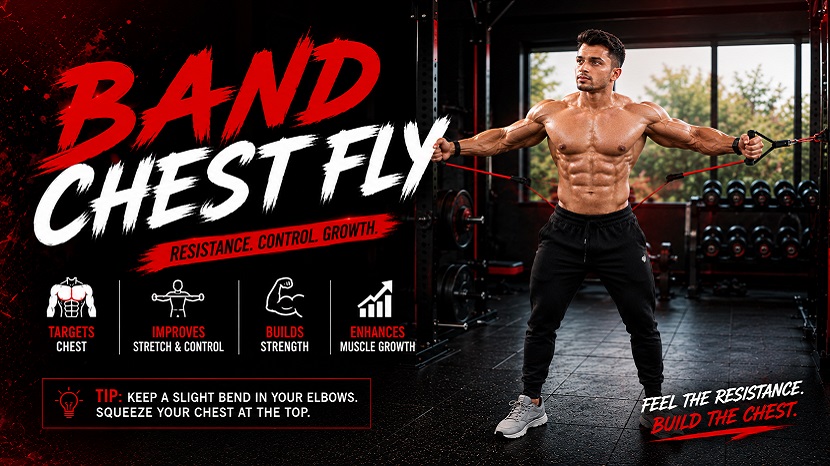
The resistance band chest fly is an isolation exercise that targets the chest muscles using the accommodating resistance of elastic bands. Also known as the band chest fly or chest fly with resistance bands, this movement mimics the motion of hugging a large tree or bringing your arms together in front of your body. Unlike free weights, the resistance band chest fly exercise provides increasing tension as the band stretches, which can enhance muscle activation during the concentric phase.
People love this exercise because it requires minimal equipment and works well for home training. Whether you call it banded chest fly or resistance band flyes, the movement delivers a strong chest pump while being gentle on the joints compared to heavy dumbbells. It fits perfectly into any resistance band chest workout or broader set of chest exercises with resistance bands.
Many fitness enthusiasts use the standing band chest fly version because it allows a full range of motion and constant tension throughout the entire movement. Learning how to do band chest fly correctly helps beginners and advanced trainees alike build a fuller, more defined chest without needing a full gym setup.
Muscles Worked by the Resistance Band Chest Fly
The primary muscle targeted by the resistance band chest fly is the pectoralis major, the large fan-shaped muscle that makes up most of your chest. This muscle has two main parts: the sternal head (lower and middle chest) and the clavicular head (upper chest). The fly motion emphasizes horizontal adduction, bringing the arms across the body.
Secondary muscles include the anterior deltoids (front of the shoulders), which assist in the movement. The serratus anterior and core muscles work to stabilize your torso and scapulae during the exercise. Your triceps and biceps act as stabilizers to keep the elbows in a safe, slightly bent position.
Because the band provides variable resistance, the band chest fly can create greater tension at the point of peak contraction compared to constant-load movements. This makes it an excellent addition to chest exercises with resistance bands when the goal is both strength and muscle definition.
Key Benefits of the Band Chest Fly
Adding the resistance band chest fly exercise to your routine offers several practical advantages that free-weight movements sometimes lack.
- Constant and variable tension: The band stretches more as you bring your arms together, matching your strength curve and keeping the chest under load longer than dumbbells in some phases of the movement.
- Joint-friendly option: Many people find the standing band chest fly puts less stress on the shoulders and wrists compared to heavy dumbbell flyes, making it suitable for those recovering from minor shoulder issues.
- Excellent for home workouts: You only need a resistance band and a sturdy anchor point. This makes the band chest fly one of the most convenient chest exercises with resistance bands for apartment dwellers or travelers.
- Improved mind-muscle connection: The slow, controlled movement and increasing tension help you feel the chest working throughout the entire range of motion.
- Progressive overload made simple: Switch to a thicker band or add pauses at the peak contraction to increase difficulty without buying new equipment.
- Great for muscle endurance and hypertrophy: Higher rep ranges (10-15) with bands create metabolic stress that supports chest growth and definition.
- Versatile for all levels: Beginners can use light bands while advanced lifters can combine the resistance band chest fly with push-ups or presses in supersets.
- Portable and affordable: A good set of resistance bands costs little and fits in a drawer, yet delivers results comparable to cable machines for many trainees.
How to Do Band Chest Fly with Proper Form
Mastering how to do band chest fly comes down to setup, body position, and controlled movement. Follow these steps for safe and effective execution of the standing band chest fly.
- 1. Select the right band and anchor point: Choose a resistance band that allows you to complete 10-15 controlled reps with good form. Anchor it securely at chest height to a door, power rack, pole, or heavy furniture. Make sure the anchor will not slip.
- 2. Set your starting position: Stand facing away from the anchor with feet in a staggered stance (one foot slightly in front). Grab the handles or ends of the band with palms facing forward or slightly inward. Step forward until you feel light tension with arms extended out to your sides at shoulder height and elbows softly bent.
- 3. Engage your core and posture: Keep your chest up, shoulders down and back, and core braced. Avoid arching your lower back or shrugging your shoulders toward your ears.
- 4. Perform the fly movement: In a wide arc, bring your hands forward and together in front of your chest as if you are hugging someone. Keep the slight bend in your elbows throughout. Squeeze your chest muscles hard at the center for one second.
- 5. Control the return: Slowly reverse the motion, letting your arms open back out to the sides with control. Take 2-3 seconds on the way back to emphasize the eccentric phase, which is excellent for muscle growth.
- 6. Breathing pattern: Exhale as you pull your arms together and squeeze the chest. Inhale as you return to the starting position with control.
Perform 3-4 sets of 10-15 repetitions. Rest 60-90 seconds between sets. Focus on quality over quantity every time you practice the resistance band chest fly exercise.
Common Mistakes to Avoid in the Standing Band Chest Fly
Even experienced trainees sometimes make errors that reduce effectiveness or increase injury risk. Here are the most frequent mistakes and how to correct them during the band chest fly.
- Locking the elbows: Straightening the arms completely shifts tension away from the chest and stresses the elbow joints. Always maintain a soft bend of about 10-15 degrees.
- Using momentum or swinging: Jerking the arms forward reduces time under tension. Slow down the movement and focus on squeezing the chest instead of throwing the arms.
- Shrugging the shoulders: Raising the shoulders toward the ears takes work away from the chest. Keep shoulder blades down and back throughout the set.
- Going too far back on the stretch: Overstretching can strain the shoulder joint. Stop when you feel a comfortable stretch in the chest without pain.
- Poor anchor choice: A wobbly anchor changes tension unpredictably. Always test the anchor with a light pull before starting your working sets.
- Rushing the eccentric phase: Letting the arms snap back quickly misses half the benefit. Control the return for 2-3 seconds every rep.
Effective Variations of Chest Fly with Resistance Bands
Once you master the basic standing band chest fly, try these variations to target different parts of the chest and keep training interesting.
- High-to-low band chest fly: Anchor the band higher than shoulder level. Pull downward and across the body. This variation emphasizes the lower chest fibers.
- Low-to-high band chest fly: Anchor the band low near the floor. Pull upward and together. This version hits the upper chest (clavicular head) more effectively.
- Single-arm band chest fly: Perform the movement one arm at a time. This increases core demand and helps correct strength imbalances between sides.
- Incline bench band fly: Lie on an incline bench and anchor bands behind you. This combines the stretch of a bench fly with band resistance for a deep chest contraction.
- No-anchor wrapped band fly: Wrap a long resistance band around your upper back and hold the ends. This version of resistance band flyes works well when you have no anchor point available.
Rotate through these variations in your resistance band chest workout to develop balanced chest development from top to bottom.
Resistance Band Chest Fly vs Dumbbell and Cable Fly Comparison
Understanding how the resistance band chest fly compares to other popular fly movements helps you choose the best tool for your goals and environment.
| Aspect | Resistance Band Chest Fly | Dumbbell Chest Fly | Cable Chest Fly |
|---|---|---|---|
| Resistance Type | Variable (increases as band stretches) | Constant | Constant |
| Equipment Needed | Resistance band + anchor | Dumbbells + bench | Cable machine |
| Portability | Excellent | Good | Poor |
| Constant Tension | High (especially at peak contraction) | Moderate | High |
| Best For | Home workouts, travel, joint comfort | Traditional gym feel, progressive loading | Consistent tension throughout full range |
| Cost | Very low | Medium | High |
| Learning Curve | Low to moderate | Moderate | Low |
The banded chest fly shines when convenience and constant tension matter most. Many people combine it with dumbbell or cable work for complete chest development.
Sample Resistance Band Chest Workout Routine
Here is a simple yet effective resistance band chest workout that incorporates the band chest fly as a key isolation move. Perform this routine 2 times per week with at least one rest day between sessions.
- Warm-up (5 minutes): Arm circles, band pull-aparts, and light push-ups to increase blood flow to the chest and shoulders.
- Banded Chest Press: 3 sets of 10-12 reps. Stand or anchor the band behind you and press forward.
- Standing Band Chest Fly: 3 sets of 12-15 reps. Focus on the squeeze and controlled return.
- Low-to-High Band Chest Fly: 3 sets of 12 reps per side or together. Target the upper chest.
- Push-Ups (or knee push-ups): 3 sets to near failure. Use full range of motion.
- Finisher - Single-Arm Band Chest Fly: 2 sets of 10-12 reps per arm. Control the tempo strictly.
Rest 60-90 seconds between sets. Total workout time is about 35-45 minutes. This routine works well as a standalone chest day or as part of a push-focused upper body session.
Programming the Band Chest Fly for Best Results
To get maximum value from the resistance band chest fly exercise, treat it like any other serious training tool. Use progressive overload by increasing band tension, adding reps, slowing the tempo, or adding pauses at peak contraction every 1-2 weeks.
For beginners, start with 2-3 sets of 12-15 reps twice per week. Intermediate trainees can handle 3-4 sets of 10-12 reps and add variations. Advanced lifters often use the banded chest fly as a finisher after heavy pressing work or in supersets with push-ups.
Pair the movement with adequate protein intake and recovery. Most people see noticeable improvements in chest size and strength within 4-6 weeks of consistent practice when they also eat in a slight calorie surplus and sleep well.
Safety Tips and Precautions for Band Chest Fly
Safety always comes first with any chest exercises with resistance bands. Inspect your band for cracks or thinning before every session. Replace bands that show wear.
Never anchor to objects that can tip over or break. If you feel shoulder pain (beyond normal muscle fatigue), stop immediately and reduce range of motion or switch to a lighter band. People with existing shoulder injuries should consult a doctor or physical therapist before starting.
Keep the movement smooth and controlled. Avoid bouncing at the bottom or locking joints at any point. Proper form protects your shoulders and elbows while delivering better chest results.
The resistance band chest fly proves that you do not need expensive machines or heavy weights to build an impressive chest. By learning how to do band chest fly with proper technique and including it regularly in your resistance band chest workout, you can develop strength, definition, and confidence from the comfort of home. Start with the basic standing band chest fly today, focus on quality repetitions, and watch your chest transform over the coming weeks. Consistency with this simple yet powerful movement will deliver results that last.
Frequently Asked Questions (FAQs)
1. What is the Band Chest Fly exercise?
Answer: The Band Chest Fly is an isolation exercise performed with resistance bands that targets the chest through a controlled, arcing motion similar to hugging a tree. It requires anchoring a resistance band behind the body at roughly chest or shoulder height, then bringing the handles forward and together in front of the chest while maintaining a slight bend in the elbows. This exercise delivers constant tension throughout the movement, making it highly effective for home workouts, travel, or as a finisher in any chest routine.
2. What muscles does the Band Chest Fly target?
Answer: The Band Chest Fly primarily works the pectoralis major, the large fan-shaped chest muscle responsible for horizontal adduction of the arms. It also engages the anterior deltoids (front shoulders) for stabilization and lightly activates the serratus anterior and core muscles. Because it is a pure isolation movement, it places minimal stress on the triceps, allowing for focused chest development, improved muscle definition, and better balance between the left and right sides of the chest.
3. How do you perform the Band Chest Fly with proper form?
Answer: Attach a resistance band with handles to a secure anchor point such as a door anchor or sturdy post at approximately shoulder height. Stand facing away from the anchor with feet staggered for stability and grasp the handles with arms extended out to your sides at chest level, keeping a soft bend in the elbows. Exhale as you bring your hands together in a wide, controlled arc in front of your chest while squeezing your pectoral muscles. Inhale as you slowly return your arms to the starting position without letting the band snap back. Keep your shoulders down and back, and avoid locking your elbows at any point.
4. What are the benefits of the Band Chest Fly?
Answer: The Band Chest Fly provides continuous tension across the full range of motion, which enhances muscle activation and promotes better chest development compared to exercises where tension drops off. It is joint-friendly, highly portable, and requires minimal equipment, making it perfect for home gyms or beginners. Regular inclusion in your routine can improve chest definition, support better posture, increase pushing strength for compound lifts, and help correct muscle imbalances when performed with focus on controlled movement and equal tension on both sides.
5. Is the Band Chest Fly good for beginners?
Answer: Yes, the Band Chest Fly is excellent for beginners because it allows easy control of resistance and emphasizes proper form over heavy loading. Start with a lighter band, perform fewer repetitions, and use a smaller range of motion until you build confidence and mind-muscle connection. It helps develop chest awareness without the balance challenges of dumbbells. Beginners should focus on slow, controlled reps, keep elbows slightly bent, and stop immediately if they feel any sharp shoulder discomfort. Consulting a trainer for initial form checks is highly recommended.
6. What common mistakes should you avoid during Band Chest Fly?
Answer: The most frequent errors include using momentum to swing the arms instead of controlled muscle action, fully locking the elbows which stresses the joints, allowing the shoulders to shrug or roll forward, and failing to squeeze the chest at the point of peak contraction. Other mistakes are selecting a band that is too heavy, causing breakdown in form, or failing to properly secure the anchor point, which can lead to dangerous band recoil. Always maintain a soft elbow bend, keep tension on the band throughout the set, and prioritize quality over quantity of repetitions.
7. How does Band Chest Fly compare to dumbbell chest fly or cable fly?
Answer: Dumbbell chest flies rely on gravity, with resistance highest at the bottom and lower at the top. Cable flies provide relatively constant tension but require gym equipment. Band Chest Fly offers increasing resistance as the band stretches, which aligns well with the chest’s strength curve and creates strong peak contraction when the hands come together. Bands are far more affordable, portable, and convenient for home use while reducing momentum-related injury risk. All three variations are effective; bands particularly excel for convenience, travel, and emphasizing the squeeze at the top of the movement.
8. What type of resistance band works best for Chest Fly exercises?
Answer: Tube-style resistance bands with comfortable, ergonomic handles are the best choice for Band Chest Fly exercises. They provide a natural grip, easy attachment to door anchors, and smooth resistance throughout the movement. Choose a medium to heavy resistance level based on your strength—beginners should start lighter to master form before progressing. Avoid mini loop bands for this exercise as they lack the required length and handle comfort. Always inspect bands for wear and use high-quality ones with secure attachment points to ensure safety and consistent tension.
9. How many sets and reps are recommended for Band Chest Fly?
Answer: For muscle growth and definition, perform 3 to 4 sets of 10 to 15 controlled repetitions per session. This rep range effectively balances hypertrophy and endurance for isolation movements. Rest 60 to 90 seconds between sets to maintain intensity while allowing recovery. Place the Band Chest Fly toward the end of your chest or push workout, after compound exercises such as push-ups or bench press variations. Train the chest 1 to 2 times per week with at least 48 hours of recovery between sessions for best results and to avoid overtraining.
10. What are advanced progressions and variations for the Band Chest Fly?
Answer: Advanced athletes can increase difficulty by using a heavier resistance band, slowing the eccentric (return) phase to 3–4 seconds per rep, or adding a 2-second isometric squeeze at full contraction. Effective variations include single-arm Band Chest Fly to correct imbalances, changing stance or anchor height for incline or decline emphasis, and supersetting with band chest presses. You can also incorporate a slight crossover at the end of each rep for extra inner chest activation or perform the movement on a stability ball to increase core demand. Always progress gradually while maintaining strict form to prevent shoulder strain or overuse injuries.