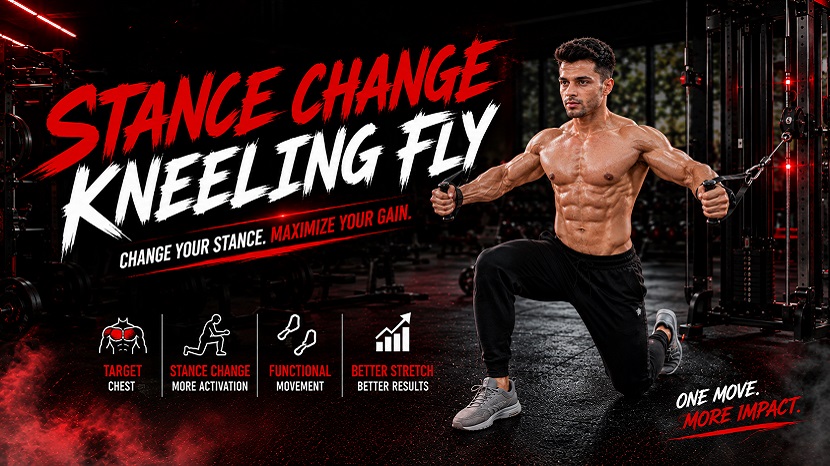
The stance change kneeling fly stands out as one of the most effective dynamic chest exercises available. It combines the classic chest fly exercise movement with deliberate stance shifts to create instability. This forces your chest muscles to work harder while your core stays engaged throughout every repetition.
This kneeling cable fly variation delivers constant tension and improved muscle activation, especially in the lower portion of the chest. It also builds functional stability that carries over to daily movements and other lifts. Whether you train at home with bands or in the gym with cables, this exercise fits perfectly as a finisher in any lower chest workout.
Content Overview
- What Is the Stance Change Kneeling Fly?
- Muscles Worked by the Stance Change Kneeling Fly
- Key Benefits of This Chest Fly Exercise
- How to Perform the Stance Change Kneeling Fly Step by Step
- Equipment Options and Proper Setup
- Common Mistakes to Avoid During the High to Low Cable Fly
- Tips for Proper Form and Better Results
- Variations and Progressions of Cable Fly Variations
- How the Stance Change Kneeling Fly Compares to Other Lower Chest Exercises
- Programming the Stance Change Kneeling Fly in Your Routine
- Safety Considerations and Beginner Modifications
- Final Thoughts
- FAQs
What Is the Stance Change Kneeling Fly?
The stance change kneeling fly is a single-arm high to low cable fly performed while alternating between a half-kneeling position and a full kneeling stance. You hold the peak contraction of the fly while shifting your stance, which increases the challenge to both your chest and core.
Unlike a standard cable chest fly done in a standing or seated position, this version removes stability on purpose. The constant tension from the cable or band keeps your muscles under load the entire time. The stance change adds an anti-rotation element that lights up your obliques and deep core muscles.
This makes the stance change kneeling fly more than just another chest fly exercise. It becomes a complete functional chest training tool that improves balance, control, and mind-muscle connection.
Muscles Worked by the Stance Change Kneeling Fly
This exercise primarily targets the lower chest exercises focus area — the sternal and costal fibers of the pectoralis major. These lower fibers create that defined lower pec line many people want.
Secondary muscles include:
- Anterior deltoids (front shoulders) for stabilization
- Serratus anterior for scapular control
- Biceps and forearms for grip and arm positioning
The real magic happens in the core. Because you perform a single-arm movement while changing stance, your obliques and transverse abdominis work hard to prevent rotation and maintain an upright torso. Your glutes and hips also stay active to keep your base solid during the transition.
This combination turns a simple chest fly exercise into a full-body stability challenge.
Key Benefits of This Chest Fly Exercise
The stance change kneeling fly offers several advantages over traditional cable fly variations:
- Superior lower chest activation — The high-to-low pulling angle combined with the hold at the bottom emphasizes the lower fibers of the pecs.
- Built-in core training — The stance shift creates anti-rotation demands similar to a Pallof press, giving you abs work without extra exercises.
- Improved mind-muscle connection — Holding the contracted position while unstable forces you to focus on squeezing the chest rather than using momentum.
- Better functional strength — Real-life movements rarely happen on perfectly stable surfaces. This dynamic chest exercises approach builds control you can use in sports and daily life.
- Constant tension — Cables or bands provide resistance through the entire range of motion, unlike dumbbells that lose tension at the top.
- Joint-friendly option — The kneeling position reduces lower back stress for many people compared to standing heavy flies.
- Great finisher — It fatigues the chest thoroughly with lighter loads, making it ideal at the end of a lower chest workout.
How to Perform the Stance Change Kneeling Fly Step by Step
Follow these steps for safe and effective execution:
- Step 1: Set up the equipment — Attach a single handle to a high cable pulley or anchor a resistance band slightly above shoulder height when kneeling.
- Step 2: Get into starting position — Kneel on one knee (right knee down for right arm work) with your left foot planted flat on the floor in front of you. Keep your torso upright, core braced, and hips square to the front. Grab the handle with your right hand, palm facing forward or slightly down.
- Step 3: Create tension — Step or lean slightly so the cable or band has tension with your arm extended out to the side at about shoulder height. Maintain a soft bend in the elbow.
- Step 4: Perform the fly — Pull the handle in a wide arc across your body toward your opposite hip or belly button area. Keep the elbow slightly bent and focus on bringing your hand to about belly-button height. Squeeze your chest hard at the end of the movement.
- Step 5: Hold and change stance — Maintain the peak contraction. Brace your core tightly, then shift your front foot backward so both knees are now on the ground in a tall kneeling position. Keep hips and shoulders square — do not twist.
- Step 6: Return to start stance — Shift the same leg forward again to the half-kneeling position while still holding the squeeze.
- Step 7: Control the return — Slowly let the handle return to the starting position with control. That completes one full repetition.
- Step 8: Complete all reps on one side — Perform 8 to 10 controlled reps, then switch arms and repeat.
Breathe out during the pulling phase and inhale on the return. Move slowly and deliberately — especially during the stance changes.
Equipment Options and Proper Setup
You can perform this kneeling cable fly with:
- Cable machine (best for smooth constant tension)
- Resistance band anchored high (excellent for home functional chest training)
- Single-arm attachment or even a towel looped through a band for variety
Set the anchor point high enough that your arm starts at or slightly above shoulder level. Too low and the angle changes from a true high to low cable fly. Use a weight or band resistance that allows perfect form for all reps — quality matters more than heavy loading here.
Common Mistakes to Avoid During the High to Low Cable Fly
Many people turn this effective move into a less useful one by making these errors:
- Rotating the torso during stance changes — this reduces chest work and stresses the lower back.
- Using too much weight — momentum takes over and you lose the squeeze.
- Straightening the elbow completely — this shifts stress to the shoulder joint.
- Rushing the stance transition — the hold is where much of the benefit occurs.
- Letting the shoulder roll forward — keep the shoulder blade stable and chest proud.
- Shortening the range of motion — reach full stretch at the start and full squeeze at the finish.
Tips for Proper Form and Better Results
- Keep your chest lifted and shoulders down and back throughout.
- Imagine hugging a large tree during the fly motion.
- Brace your core as if someone is about to push you from the side.
- Move slowly — take 2 to 3 seconds on the return phase.
- Film yourself from the side to check that hips and shoulders stay square.
- Start with bodyweight or very light resistance until the coordination feels natural.
- Pair it with a compound movement like push-ups or bench press earlier in the session.
Variations and Progressions of Cable Fly Variations
Once you master the basic stance change kneeling fly, try these progressions:
- Both knees down throughout — removes the stance change but increases stability demand on the core.
- Add a pulse at the bottom — small pulses in the contracted position before returning.
- Slow eccentric — take 4 seconds to return the handle.
- Resistance band version at home — great for travel or minimal equipment lower chest workout sessions.
- Alternating arms — perform one rep right, then immediately one rep left for increased core challenge.
- Incline bench support — rest your non-working hand on an incline bench for slight assistance when learning.
How the Stance Change Kneeling Fly Compares to Other Lower Chest Exercises
Here is a quick comparison:
| Exercise | Primary Focus | Core Engagement | Equipment Needed | Best Used As |
|---|---|---|---|---|
| Stance Change Kneeling Fly | Lower chest + stability | High (anti-rotation) | Cable or band | Finisher |
| Standard Standing Cable Fly | Overall chest | Low | Cable machine | Mid-workout |
| Dumbbell Chest Fly | Chest stretch | Low | Dumbbells + bench | Hypertrophy work |
| High to Low Cable Fly (standing) | Lower chest | Moderate | Cable machine | Strength building |
| Decline Dumbbell Press | Lower chest power | Moderate | Bench + dumbbells | Compound movement |
The stance change kneeling fly wins for people who want extra core work and better contraction quality in their lower chest exercises routine.
Programming the Stance Change Kneeling Fly in Your Routine
Use this exercise 1 to 2 times per week as a finisher. Perform 3 sets of 8 to 12 reps per side. Rest 60 to 90 seconds between sets.
It pairs well after:
- Flat or incline bench press
- Push-up variations
- Dips or cable crossovers
Because it is relatively low-load and high-control, it works great on days when you want to emphasize quality over heavy weight. It also fits nicely in supersets or circuits when you want to keep the heart rate elevated.
Safety Considerations and Beginner Modifications
If you have shoulder instability or recent shoulder injuries, master regular cable chest fly variations first before adding stance changes. Always warm up your shoulders and chest with light sets or arm circles.
Beginners should:
- Practice the fly motion without any stance change first.
- Use a very light band or low cable weight.
- Keep the range smaller until control improves.
- Work with a trainer or mirror to check form.
Stop immediately if you feel sharp pain (muscle burn is normal; joint pain is not).
Final Thoughts
The stance change kneeling fly proves that sometimes the best chest fly exercise is not the heaviest one. By combining a high to low cable fly with deliberate stance shifts, you get deeper lower chest activation, serious core work, and improved body control in one efficient movement.
Add this dynamic chest exercises variation to your next lower chest workout and you will notice better definition, stronger contractions, and more functional stability within just a few sessions. Focus on form, control the tempo, and enjoy the burn that comes from truly challenging your chest and core together.
This exercise delivers real results for anyone serious about building a strong, defined, and functional upper body. Start incorporating the stance change kneeling fly today and experience the difference that smart instability training can make.
Frequently Asked Questions (FAQs)
1. What is the Stance Change Kneeling Fly chest exercise?
Answer: The Stance Change Kneeling Fly is a dynamic chest isolation exercise performed in a kneeling position on the floor. It combines the classic fly movement with controlled transitions between different kneeling stances such as tall kneeling and half-kneeling. This variation adds instability that challenges core stability while targeting the chest muscles from unique angles, making it an effective addition to any chest workout routine.
2. What muscles does the Stance Change Kneeling Fly target?
Answer: The Stance Change Kneeling Fly primarily targets the pectoralis major and pectoralis minor muscles of the chest. Secondary muscles worked include the anterior deltoids, triceps, and core stabilizers such as the abdominals and obliques. The stance transitions increase demand on the glutes, hips, and deep core muscles for balance and control throughout the movement.
3. How do you perform the Stance Change Kneeling Fly with proper form?
Answer: Start in a tall kneeling position on an exercise mat while holding a dumbbell in each hand. Keep your core braced, back straight, and shoulders down. With a slight bend in the elbows, open your arms out to the sides at chest height. Bring the dumbbells together in a wide arc in front of your chest while squeezing your pecs. Slowly return to the starting position. Then transition into a half-kneeling stance by stepping one foot forward and continue performing the fly movement, alternating stances every few reps.
4. What equipment is required to do the Stance Change Kneeling Fly?
Answer: You need a pair of dumbbells with a weight that allows full control, an exercise mat for knee comfort and stability, and enough floor space to move. A cable machine with D-handles can be used as an alternative for constant tension. No bench is required. A mirror is helpful for checking form during the stance transitions.
5. Is the Stance Change Kneeling Fly appropriate for beginners?
Answer: Yes, the Stance Change Kneeling Fly is suitable for beginners when started with light dumbbells or no weight at all. Focus first on learning the basic fly motion and maintaining neutral spine position before adding frequent stance changes. Begin with 2 sets of 8–10 controlled reps and gradually increase difficulty as form improves and core strength develops.
6. What common mistakes should you avoid when performing the Stance Change Kneeling Fly?
Answer: Common mistakes include using weights that are too heavy, causing swinging or loss of control; fully locking the elbows; arching the lower back; rounding the shoulders forward; and rushing through stance transitions without bracing the core. Always prioritize slow, controlled movement and proper posture over speed or heavier loads to prevent injury and maximize chest activation.
7. What are the benefits of the Stance Change Kneeling Fly in a chest workout routine?
Answer: This exercise provides excellent chest isolation and development while reducing lower back stress compared to lying fly variations. The stance changes improve core strength, balance, and hip stability. It adds valuable variety to training, helps break plateaus, enhances mind-muscle connection, and builds functional strength that carries over to daily activities and sports performance.
8. How does the Stance Change Kneeling Fly compare to other chest fly variations?
Answer: Unlike lying dumbbell flies that use a bench for back support, the kneeling version requires greater core engagement and eliminates spinal support. Compared to standing cable or dumbbell flies, it limits momentum and adds lower body stability demands through stance changes. This creates a more functional, full-body challenge while still delivering focused chest work from different angles.
9. Can people with shoulder or knee injuries perform the Stance Change Kneeling Fly?
Answer: People with shoulder or knee issues should consult a doctor or physical therapist before trying this exercise. Safe modifications include reducing range of motion, using resistance bands instead of dumbbells, performing static tall kneeling flies without stance changes, or switching to machine-based fly variations. Stop immediately if you feel sharp pain and always warm up thoroughly.
10. What sets and reps are recommended for the Stance Change Kneeling Fly exercise?
Answer: Perform 3 to 4 sets of 10 to 15 controlled repetitions, changing stance every 4–5 reps within each set. Rest 60–90 seconds between sets. Beginners should start with 2–3 sets of 8–12 reps using lighter weights. Intermediate and advanced lifters can increase intensity by slowing the eccentric phase, adding pauses at peak contraction, or using slightly heavier dumbbells while maintaining perfect form.