The standing one arm landmine press is a highly effective compound movement that builds upper body strength while improving stability and balance. This landmine press exercise stands out in any chest workout because it targets the upper chest, shoulders, and triceps through a natural arc that feels more joint-friendly than traditional overhead or flat pressing movements.
Whether you train at home with minimal equipment or in a commercial gym, the one arm landmine press delivers serious results. It challenges your core, corrects left-to-right imbalances, and translates well to everyday pushing tasks and other lifts like the bench press.
Contents Overview
- What Is the Standing One Arm Landmine Press?
- Landmine Press Muscles Worked
- Key Landmine Press Benefits
- How to Perform the Standing One Arm Landmine Press Step by Step
- Proper Landmine Press Form and Key Technique Cues
- Common Mistakes to Avoid During the One Arm Landmine Press
- Effective Variations of the Landmine Chest Press and Unilateral Press
- Standing One Arm Landmine Press vs Other Chest Exercises (Comparison)
- How to Add the Landmine Press for Chest Development Into Your Routine
- Safety Tips and Who Benefits Most from This Exercise
- Final Thoughts
- FAQs
What Is the Standing One Arm Landmine Press?
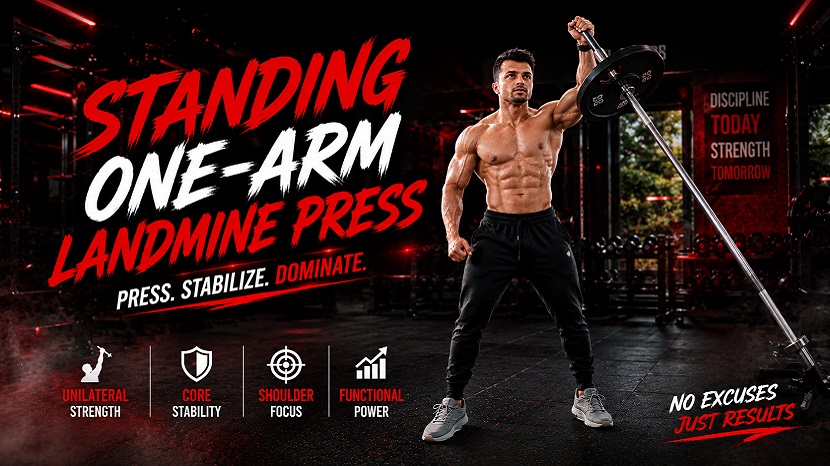
The standing one arm landmine press uses a barbell anchored at one end in a landmine attachment or securely wedged into a corner. You grip the free end with one hand and press it upward and slightly forward while standing.
Unlike a standard barbell or dumbbell overhead press, the angled path of the unilateral landmine press allows your shoulder blade to move more naturally. This makes the movement feel smoother and often more comfortable for people with shoulder mobility limitations.
When performed with a slight forward lean and controlled path, this exercise also functions as an excellent landmine chest press variation. It lights up the upper chest without requiring a bench, making it ideal for home workouts or as a fresh stimulus in your chest training.
Landmine Press Muscles Worked
Understanding landmine press muscles worked helps you appreciate why this movement is so valuable. It is a true compound exercise that recruits multiple muscle groups simultaneously.
Primary muscles targeted:
- Anterior deltoids (front shoulders) — the main drivers of the pressing action.
- Upper chest (clavicular head of the pectoralis major) — heavily involved due to the horizontal and vertical pressing combination, similar to a low-incline movement.
- Triceps brachii — assist powerfully during the lockout phase.
Secondary and stabilizing muscles:
- Core (especially obliques and deep abdominals) — work hard to resist rotation and maintain an upright torso.
- Scapular stabilizers and serratus anterior — keep the shoulder blade controlled throughout the range of motion.
- Upper trapezius and rotator cuff muscles — provide additional shoulder stability.
- Glutes and legs — engage to maintain a stable base in the standing position.
Because it is performed one side at a time, the single arm landmine press also improves neuromuscular coordination and helps eliminate strength imbalances between sides.
Key Landmine Press Benefits
The landmine press benefits extend far beyond simple muscle building. Here are the most important advantages:
- Superior upper chest development — The angled pressing path hits the clavicular head of the chest effectively, giving you a fuller, more balanced chest appearance.
- Joint-friendly shoulder training — The natural arc reduces stress on the rotator cuff compared to straight overhead pressing.
- Enhanced core strength and stability — Unilateral loading forces your core to resist twisting, building real-world anti-rotational strength.
- Correction of muscle imbalances — Training one arm at a time reveals and fixes left-to-right differences that bilateral exercises often hide.
- Improved scapular control — Better shoulder blade movement carries over to safer, stronger performance in bench press, push-ups, and daily activities.
- Functional strength gains — The standing position and diagonal path mimic real-life pushing movements better than many machine or bench-based exercises.
- Versatility for all levels — Easy to scale with lighter loads for beginners or heavier weights for advanced lifters.
- Minimal equipment requirement — All you need is a barbell and a landmine attachment or sturdy corner.
- Better posture and shoulder health — Strengthening the serratus and upper back muscles supports healthier shoulder positioning over time.
- Time-efficient full upper body stimulus — One exercise delivers chest, shoulder, triceps, and core work simultaneously.
These combined benefits explain why so many experienced lifters include the standing one arm landmine press in their programs.
How to Perform the Standing One Arm Landmine Press Step by Step
Follow these instructions carefully to get the most out of the one arm landmine press while staying safe.
- 1. Set up the landmine by placing one end of a barbell into the landmine attachment or wedging it securely into a corner. Add weight plates to the free end — start light until you master the movement.
- 2. Stand with your feet about hip-width apart or in a staggered stance (opposite foot of the working arm slightly forward). Keep your chest tall and core braced.
- 3. Grip the end of the barbell with one hand, palm facing inward or slightly upward. Bring the bar to shoulder height so it rests near the front of your shoulder. Place your non-working hand on your ribcage or hip for balance and to monitor core engagement.
- 4. Take a deep breath, brace your core tightly, and create tension through your glutes and legs.
- 5. Press the bar upward and slightly forward in a smooth arc. Think of punching toward the ceiling at a 45-degree angle rather than straight overhead.
- 6. Fully extend your arm at the top without locking the elbow aggressively. Keep your shoulder blade pulled back and down.
- 7. Lower the bar slowly and with control back to the starting position at your shoulder. Resist the weight on the way down.
- 8. Complete all repetitions on one side before switching arms. Breathe out during the pressing phase and inhale as you lower.
Perform 3 to 4 sets of 8 to 12 repetitions per arm for most chest and upper body goals.
Proper Landmine Press Form and Key Technique Cues
Mastering proper landmine press form is essential for both results and injury prevention.
- Keep a neutral spine — avoid excessive arching in your lower back by bracing your core and tucking your ribs down.
- Maintain a slight forward lean from the hips (not the waist) to stay aligned with the bar’s natural path.
- Drive the movement from your chest and shoulder rather than shrugging your trap.
- Keep your wrist straight — cup the bar in the lower part of your palm instead of bending the wrist backward.
- Move with control on both the concentric (pressing) and eccentric (lowering) phases. The lowering portion builds significant muscle.
- Use a staggered stance if you feel your lower back arching — this often provides better stability for beginners.
- Keep your head neutral and gaze forward or slightly upward — do not let your head jut forward.
These small details separate an average repetition from a highly effective one that maximizes landmine press for chest activation.
Common Mistakes to Avoid During the One Arm Landmine Press
Even experienced lifters sometimes make these errors. Correcting them will dramatically improve your results and safety.
- Arching the lower back excessively — This usually happens when the core is not braced or the weight is too heavy. Fix it by tightening your abs and glutes before each rep.
- Pressing straight up instead of in an arc — The bar should travel up and slightly away from your body. Straight vertical pressing reduces chest involvement and increases shoulder stress.
- Letting the elbow flare too wide or collapse inward — Keep the elbow under the bar and in line with your wrist for optimal force transfer.
- Using momentum or leg drive — This turns the exercise into a push press and reduces chest and shoulder work. Stay controlled.
- Shrugging the shoulder toward the ear — Keep the shoulder blade down and back throughout the movement.
- Incomplete range of motion — Lower the bar fully to shoulder level and press to near full extension for complete muscle development.
- Poor breathing pattern — Holding your breath or breathing incorrectly reduces core stability and power. Exhale on the way up.
- Starting with too much weight — Begin conservatively. Perfect form with moderate weight produces better long-term gains than heavy weight with sloppy technique.
Effective Variations of the Landmine Chest Press and Unilateral Press
Once you master the basic standing one arm landmine press, try these progressions and variations:
- Half-kneeling single arm landmine press — Kneel on the same-side knee as the working arm. This reduces lower body involvement and increases core demand.
- Tall kneeling landmine press — Both knees down for even greater anti-rotation challenge.
- Bilateral landmine chest press — Use both hands on the bar for a more traditional chest-focused movement.
- Landmine push press — Add a small leg dip and drive to move heavier loads explosively.
- Sideways upper chest landmine press — Stand perpendicular to the bar and press across your body to emphasize the upper chest even more.
- Single arm landmine thruster — Combine a squat with the press for full-body conditioning.
Each variation changes the stability and muscle emphasis slightly while keeping the core principles of the landmine press exercise intact.
Standing One Arm Landmine Press vs Other Chest Exercises (Comparison)
Here is a clear comparison to help you understand where this movement fits in your training:
| Exercise | Primary Chest Emphasis | Core & Stability Demand | Joint Friendliness | Best For |
|---|---|---|---|---|
| Standing One Arm Landmine Press | Upper chest (strong) | High (anti-rotation) | High | Functional strength, balance, home gyms |
| Flat Barbell Bench Press | Mid chest (very strong) | Low to moderate | Moderate | Maximal strength and mass |
| Incline Dumbbell Press | Upper chest (strong) | Low | Moderate | Upper chest isolation |
| Overhead Barbell Press | Minimal direct chest | Moderate | Lower for many people | Shoulder strength and size |
| Push-Ups | Full chest | Moderate to high | High | Bodyweight endurance and stability |
The standing one arm landmine press shines as a complementary movement rather than a complete replacement for heavy bench pressing. It adds variety, improves shoulder health, and builds the kind of functional pressing strength that carries over to sports and daily life.
How to Add the Landmine Press for Chest Development Into Your Routine
Place the landmine press for chest work early or in the middle of your chest or push workout, after your main heavy pressing movement.
Sample Chest Workout Integration:
- Barbell or Dumbbell Bench Press — 4 sets of 6-8 reps
- Incline Dumbbell Press — 3 sets of 8-10 reps
- Standing One Arm Landmine Press — 3-4 sets of 8-12 reps per arm
- Cable Flyes or Pec Deck — 3 sets of 12-15 reps
- Optional finisher: Push-ups or dips
Recommended sets and reps:
- Strength focus: 4-5 sets of 4-6 reps per arm with heavier weight
- Hypertrophy focus: 3-4 sets of 8-12 reps per arm
- Endurance or conditioning: 3 sets of 12-15+ reps with shorter rest
Rest 60-90 seconds between arms or sets. Perform this exercise 1-2 times per week with at least 48 hours between sessions for recovery.
Safety Tips and Who Benefits Most from This Exercise
The standing one arm landmine press is generally very safe when performed with good technique, but keep these points in mind:
- Always warm up thoroughly with lighter sets and shoulder mobility drills.
- If you have existing shoulder impingement or pain, start with very light weight or consult a qualified trainer or physical therapist.
- People recovering from lower back issues should focus on perfect core bracing and consider the half-kneeling version first.
- Beginners should master the movement with an empty bar or very light plates before adding significant weight.
- Pregnant individuals or those with balance concerns may prefer the kneeling variations.
This exercise benefits almost everyone — from beginners building a foundation to advanced lifters seeking new stimuli and better shoulder resilience.
Final Thoughts
The standing one arm landmine press is one of the most underrated yet highly effective tools in any serious lifter’s arsenal. It delivers excellent landmine press for chest development, builds functional strength, improves core stability, and does so in a joint-friendly manner that many traditional presses cannot match.
By focusing on proper landmine press form, avoiding common mistakes, and strategically programming the movement into your chest or upper body days, you will notice better muscle balance, stronger pressing power, and improved shoulder health over time.
Whether your goal is a fuller upper chest, greater overall strength, or simply adding smart variety to your training, the unilateral landmine press deserves a permanent place in your routine. Start light, prioritize technique, stay consistent, and enjoy the results.
Frequently Asked Questions (FAQs)
1. What is the standing one-arm landmine press?
Answer: The standing one-arm landmine press is a unilateral chest exercise performed while standing, using a barbell secured in a landmine attachment or corner. It involves pressing the angled bar upward with one arm in a natural arc. This movement is highly effective for chest workouts because it targets the upper pectorals while also building shoulder stability and core strength through the standing position.
2. Which muscles does the standing one-arm landmine press target?
Answer: The standing one-arm landmine press primarily targets the upper chest, specifically the clavicular head of the pectoralis major. Secondary muscles worked include the anterior deltoids (front shoulders) and triceps brachii. Because the exercise is performed standing and unilaterally, the core muscles—particularly the obliques and deep abdominal stabilizers—engage strongly to resist rotation and maintain an upright posture.
3. How do you perform the standing one-arm landmine press with proper form?
Answer: Start by placing a barbell in a landmine attachment and loading it with an appropriate weight. Stand with feet shoulder-width apart in a stable athletic stance, holding the bar near shoulder height with one hand and elbow pointing downward. Brace your core tightly, keep your chest tall, and press the bar upward and slightly across your midline in a controlled arc until your arm is fully extended. Pause briefly at the top, then lower the bar slowly back to the starting position. Complete all repetitions on one side before switching arms, and exhale forcefully during the pressing phase.
4. What are the main benefits of the standing one-arm landmine press in a chest workout?
Answer: The standing one-arm landmine press delivers excellent upper chest development due to its angled pressing path. It helps correct left-to-right muscle imbalances, strengthens the core through anti-rotational demands, and improves shoulder mobility and stability. Performing the movement while standing also makes it more functional for athletic performance and daily pushing activities compared to traditional lying bench presses.
5. Is the standing one-arm landmine press suitable for beginners?
Answer: Yes, the standing one-arm landmine press is suitable for beginners when started with light weight and strict focus on technique. It teaches valuable skills in core bracing and unilateral strength development. Beginners should master the movement pattern with an empty bar or very light plates first. If standing balance feels challenging initially, the half-kneeling variation offers a stable way to learn the pattern before progressing to the full standing version.
6. What common mistakes should you avoid when doing the standing one-arm landmine press?
Answer: Common mistakes include using momentum by twisting the torso or leaning excessively backward, failing to brace the core, and choosing weights that are too heavy for controlled movement. Other errors involve incomplete range of motion, letting the elbow flare outward, shrugging the shoulder toward the ear, or rushing the lowering phase. Always prioritize smooth, controlled repetitions and film your sets to check your form.
7. How does the standing one-arm landmine press compare to the dumbbell bench press or barbell bench press?
Answer: Unlike the dumbbell or barbell bench press performed lying down, the standing one-arm landmine press is done upright and unilaterally. This creates greater core engagement and makes it easier to spot and correct strength imbalances between sides. The fixed arc of the landmine bar often feels more shoulder-friendly than a straight bar path for many lifters. It works best as a complementary accessory exercise rather than a full replacement for horizontal pressing movements in a chest routine.
8. What are some variations and progressions for the standing one-arm landmine press?
Answer: Effective variations include the half-kneeling and tall-kneeling landmine presses, which increase core and hip stability demands. Advanced progressions involve adding a controlled rotation at the top of the movement, using slower eccentric tempos for greater time under tension, or progressing to a single-leg standing version for extra balance challenge. You can also increase the load gradually while maintaining perfect form or incorporate it into mechanical drop sets by changing positions as fatigue sets in.
9. How many sets and reps should you do for the standing one-arm landmine press?
Answer: Perform 3 to 4 sets of 8 to 12 repetitions per arm for most training goals. This rep range effectively supports muscle growth and strength development in the chest, shoulders, and triceps. Rest 60 to 90 seconds between arms or complete sets. Include the exercise 1 to 2 times per week in your push or chest workout, typically after your main compound pressing movements like bench press.
10. What safety tips help prevent injury during the standing one-arm landmine press?
Answer: Always warm up your shoulders, upper back, and thoracic spine thoroughly before starting. Choose a weight that allows you to maintain strict form for every repetition without compensation. Keep your core braced and lower back neutral rather than overarching. Stop immediately if you feel sharp shoulder or elbow pain. Ensure the landmine attachment is stable, use collars on the bar when appropriate, and progress weight slowly as your strength and technique improve over time.