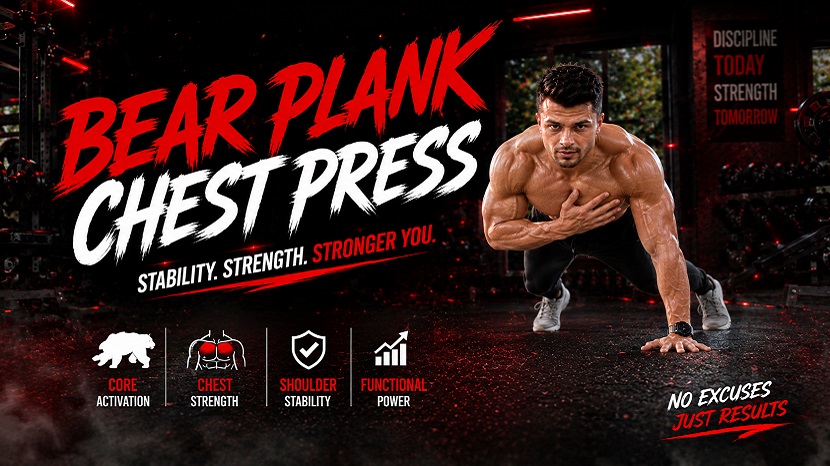
The bear plank chest press is a smart and challenging movement that combines upper body pressing power with serious core demands. It stands out from traditional chest exercises because it forces your body to stay stable while you press. This creates an intense anti-rotation chest press effect that ordinary bench presses rarely deliver.
Developed and popularized by top strength coaches, this exercise uses a cable chest press variation performed from the bear plank position. The result is a complete chest and core workout that builds muscle, improves stability, and enhances real-world strength. Whether you are an intermediate lifter looking for new advanced chest exercises or someone focused on functional chest training, mastering this move can take your workouts to the next level.
Contents Overview
- What Makes the Bear Plank Chest Press Unique
- Understanding the Bear Plank Position
- How to Do Bear Plank Chest Press with Perfect Form
- Muscles Worked in the Bear Plank Chest Press
- Top Bear Plank Chest Press Benefits Backed by Science
- Common Mistakes to Avoid
- Modifications and Variations for All Levels
- How to Add It to Your Workout Routine
- Comparison with Other Chest and Core Exercises
- Safety Tips and Best Practices
- Final Thoughts
- FAQs
What Makes the Bear Plank Chest Press Unique
Most chest presses happen while lying on a bench or standing upright. The bear plank chest press changes everything by placing you in a low, unstable position on all fours with your knees hovering just above the ground. From there you perform a downward pressing motion against cable or band resistance.
This setup prevents you from arching your lower back, which often happens during heavy bench pressing. Your chest must work through a fuller range of motion while your core fights hard to keep everything aligned. The unilateral nature of the movement adds a powerful anti-rotation chest press challenge that improves athletic performance and daily movement quality.
Understanding the Bear Plank Position
Before you attempt the full bear plank chest press, you need a strong foundation in the bear plank position itself. This isometric hold is one of the most effective ways to train deep core muscles without putting excessive stress on the lower back.
To get into the basic bear plank, start on your hands and knees with wrists under shoulders and knees under hips. Spread your fingers wide and press firmly into the floor. Engage your glutes to tuck your tailbone slightly and brace your abs as if someone is about to punch your stomach. Lift your knees just one inch off the ground while keeping your back flat and head in a neutral position looking down.
Hold this position while breathing steadily. The bear plank position activates the transverse abdominis and obliques more effectively than a traditional high plank for many people because the bent-knee setup allows better control and deeper bracing.
How to Do Bear Plank Chest Press with Perfect Form
If you want to learn how to do bear plank chest press safely and effectively, follow these detailed instructions.
- Step 1: Set up a cable machine with handles attached at a high point or anchor heavy resistance bands to a sturdy overhead bar such as a pull-up bar. The resistance should pull upward so you press downward against it.
- Step 2: Get into the bear plank position with your core braced, glutes engaged, and knees hovering just above the floor. Grab the cable handles or band handles with a firm grip. Keep your wrists straight and elbows close to your body.
- Step 3: Shift one arm back slightly toward your torso while keeping your hips and shoulders perfectly square to the ground. Pause briefly to feel the tension and maintain total body tension.
- Step 4: Press the handle straight down toward the floor in a controlled motion. Focus on driving through your chest while your core resists any twisting or lifting of the hips. Exhale as you press.
- Step 5: Slowly return the arm to the starting position with control. Repeat on the other side. That counts as one full repetition.
Perform 3 sets of 8 to 10 quality repetitions per side. Rest 60 to 90 seconds between sets. Focus on form and core bracing rather than heavy weight, especially when first learning how to do bear plank chest press.
Muscles Worked in the Bear Plank Chest Press
This exercise is a true compound movement that trains multiple areas at once. Here is a breakdown of the primary and supporting muscles involved.
| Muscle Group | Primary Role | Key Muscles Targeted |
|---|---|---|
| Chest | Primary mover | Pectoralis major and minor |
| Core | Stabilizer and anti-rotator | Transverse abdominis, internal and external obliques, rectus abdominis |
| Shoulders | Stabilizer and assister | Anterior deltoids, rotator cuff muscles |
| Arms | Assister | Triceps brachii |
| Lower Body | Isometric stabilizer | Glutes, quadriceps |
The combination of pressing and anti-rotation work makes this one of the most efficient chest and core workout options available.
Top Bear Plank Chest Press Benefits Backed by Science
The bear plank chest press benefits go far beyond simple muscle building. Research on core training shows that exercises like the bear plank improve deep stabilizer activation, which helps reduce low back pain risk and enhances athletic performance in sports requiring quick changes of direction and powerful pushing movements.
Because you cannot arch your back during the press, your chest works through its fullest possible range. This leads to better muscle development in the pectorals compared to some traditional pressing variations. At the same time, the anti-rotation chest press element strengthens your obliques and transverse abdominis, giving you a more stable midsection for everyday activities and heavy lifting.
Other notable bear plank chest press benefits include improved posture, better shoulder stability, increased glute and quad endurance, and greater overall body control. It serves as an excellent functional chest training tool because the movement pattern translates well to real-life pushing tasks while keeping your core engaged the entire time.
Common Mistakes to Avoid
Even experienced lifters make errors when first trying this exercise. Watch out for these common issues to stay safe and get better results.
- Allowing the hips or shoulders to rotate – This removes the anti-rotation benefit and increases injury risk. Keep everything square to the floor.
- Using too much weight too soon – Heavy loads make it impossible to maintain a flat back and strong core brace. Start light and prioritize control.
- Losing core tension or letting the lower back sag – Re-brace your abs before every repetition and keep your ribs pulled down toward your pelvis.
- Shrugging the shoulders or bending the wrists – Maintain neutral shoulders and straight wrists throughout the movement.
- Holding your breath – Breathe out during the press and maintain steady breathing to support core bracing.
Modifications and Variations for All Levels
Beginners can regress the movement by keeping one or both knees lightly on the ground or using very light resistance while focusing on the bear plank position hold. Another option is to perform the bear plank hold without the press first to build core endurance.
For more advanced trainees, slow the lowering phase to three seconds, add a two-second pause at the bottom of each press, or increase resistance gradually. You can also perform the exercise as a finisher after your main chest work for an intense chest and core workout burnout.
If you train at home, heavy resistance bands anchored high work very well as a cable chest press variation substitute. Always ensure your anchor point is completely secure before starting.
How to Add It to Your Workout Routine
Place the bear plank chest press near the end of your chest or push day as a chest day finisher. It works best after your heavier compound movements like bench press or overhead press.
Here is a simple example of how to include it in a push-focused session:
- Bench Press – 4 sets of 6-8 reps
- Overhead Press – 3 sets of 8-10 reps
- Incline Dumbbell Press – 3 sets of 10-12 reps
- Bear Plank Chest Press – 3 sets of 8-10 reps per side
Perform this workout 1-2 times per week with at least 48 hours of recovery between sessions. As you get stronger, you can increase resistance or add an extra set.
Comparison with Other Chest and Core Exercises
| Exercise | Core Demand | Equipment Needed | Best For |
|---|---|---|---|
| Bear Plank Chest Press | Very High (anti-rotation + anti-extension) | Cable or bands | Functional strength and stability |
| Traditional Bench Press | Low to moderate | Barbell or dumbbells | Maximum chest strength and size |
| Standard Cable Chest Press | Moderate | Cable machine | Constant tension chest work |
| Bear Plank Hold | High (isometric) | Bodyweight | Pure core endurance |
The bear plank chest press fills a unique gap by delivering both chest stimulus and high-level core stability training in a single movement.
Safety Tips and Best Practices
Always warm up properly with dynamic movements such as cat-cow stretches, shoulder circles, and light bear plank holds before attempting the full exercise. Make sure your cable or band setup is secure to prevent sudden release of tension.
If you have existing shoulder, wrist, or lower back issues, consult a qualified trainer or physical therapist before adding this movement. Start with bodyweight bear plank holds and progress slowly. Never sacrifice form for extra repetitions or heavier resistance.
Listen to your body. If you feel sharp pain (as opposed to normal muscle fatigue), stop immediately and reassess your form or reduce the load.
Final Thoughts on Building Real Strength
The bear plank chest press is more than just another chest exercise. It represents smart, efficient training that builds usable strength while protecting your body. By combining pressing power with intense core stability training, it delivers benefits that carry over into sports, daily activities, and long-term joint health.
Whether you are looking for new advanced chest exercises or simply want a better chest and core workout, this movement deserves a place in your program. Focus on quality over quantity, progress gradually, and stay consistent. Over time you will notice stronger presses, a more stable midsection, and improved overall body control.
Start practicing the bear plank position today, then add the pressing component once you feel confident. Your chest, core, and functional strength will thank you for it.
Frequently Asked Questions (FAQs)
1. What is the Bear Plank Chest Press exercise?
Answer: The Bear Plank Chest Press is an advanced compound chest workout that combines the deep core stabilization of a bear plank hold with the pressing power of a dumbbell chest press. Performed on the floor in a hovering quadruped position, it challenges your entire body to remain stable while you press weights overhead. This makes it far more demanding on coordination, balance, and core strength than a traditional bench press or regular plank.
2. Which muscles does the Bear Plank Chest Press target?
Answer: This exercise primarily targets the pectoralis major (chest), anterior deltoids (front shoulders), and triceps. The bear plank position heavily recruits the entire core including the rectus abdominis, transverse abdominis, and obliques, while also engaging the glutes, quadriceps, lower back, serratus anterior, and scapular stabilizers. It delivers simultaneous chest development and full-body tension that improves functional strength and posture.
3. How do you perform the Bear Plank Chest Press correctly?
Answer: Start on all fours with hands under shoulders and knees under hips. Brace your core tightly and lift your knees 2–4 inches off the floor so only your hands and toes support you (bear plank position). Keep your back flat and hips level. Hold a dumbbell in each hand. While maintaining perfect stability and resisting any hip rotation or back arch, press the dumbbells straight up toward the ceiling by extending your elbows. Lower the weights slowly with control. You can press both arms together or alternate for extra core challenge. Exhale on the press and inhale on the way down. Move with control and keep constant tension in your core and glutes.
4. What equipment do you need for the Bear Plank Chest Press?
Answer: You only need a pair of dumbbells (start with light to moderate weights such as 5–15 lbs per hand depending on your strength) and optionally a yoga mat for floor comfort. No bench, rack, or gym machines are required. This makes the exercise highly accessible for home workouts, travel, or minimal-equipment training sessions.
5. What are the key benefits of the Bear Plank Chest Press?
Answer: The Bear Plank Chest Press builds chest size and strength while dramatically improving core stability and endurance. It enhances shoulder stability, posture, and scapular control. Because it demands full-body tension, it increases calorie burn, improves coordination and balance, and develops functional strength useful for sports and daily activities. It also helps prevent injuries by strengthening often-neglected stabilizing muscles around the shoulders and core.
6. Is the Bear Plank Chest Press suitable for beginners?
Answer: This is an intermediate to advanced exercise because it requires solid core strength, shoulder stability, and body control. Beginners should first master the standard bear plank hold (without weights) and a basic floor or dumbbell chest press separately. Once those feel comfortable, progress to the combined movement using very light dumbbells and fewer repetitions. If you have wrist, shoulder, or lower-back issues, consult a trainer or physical therapist before attempting it.
7. What are the most common mistakes to avoid with the Bear Plank Chest Press?
Answer: Common errors include letting the hips sag or twist, arching the lower back, using momentum instead of controlled movement, holding the breath, and choosing weights that are too heavy. Many people also allow their shoulders to shrug or lose scapular stability. To avoid these, prioritize perfect form over heavy weight, start light, film your sets for feedback, and keep your core braced and glutes engaged throughout every repetition.
8. How many sets and reps should you do for the Bear Plank Chest Press?
Answer: Perform 3–4 sets of 8–12 repetitions per arm (if alternating) or total presses. Beginners can start with 2–3 sets of 6–8 controlled reps using lighter dumbbells. Rest 60–90 seconds between sets. For muscle growth, focus on the 8–12 rep range with good form. For strength, use slightly heavier weights and lower reps (6–8). Always progress gradually and stop if form breaks down.
9. What variations and progressions are available for this exercise?
Answer: Effective variations include alternating single-arm presses for greater anti-rotational core demand, slowing the tempo (especially the lowering phase), adding a 2-second pause at the top of each press, or performing the movement on an unstable surface such as a BOSU ball (advanced). You can also regress by keeping your knees on the floor or progress by increasing dumbbell weight, extending plank hold time between reps, or transitioning into a full high-plank chest press position for even more challenge.
10. What safety tips and precautions should you follow?
Answer: Always warm up with light cardio and dynamic stretches. Maintain a neutral spine and never allow your lower back to arch. Stop immediately if you feel shoulder, wrist, or lower-back pain. People with wrist issues can use push-up bars or perform the movement on their fists. Stay hydrated, breathe continuously, and progress slowly. If you have any pre-existing joint or core conditions, obtain medical clearance before adding this exercise to your routine.