The single arm dumbbell bench press stands out as one of the most effective unilateral exercises for building a strong, balanced chest. Unlike traditional bilateral movements, this variation challenges your body in new ways. It improves stability, addresses muscle imbalances, and strengthens your core at the same time.
Many lifters turn to the one arm dumbbell bench press when they want more than just bigger pecs. They want better pressing mechanics and real-world strength that carries over to daily life and other lifts. Whether you train at home or in a commercial gym, learning proper single arm dumbbell chest press technique can transform your chest workouts.
This guide covers everything you need. You will learn exactly how to do single arm dumbbell bench press with perfect form, understand the full benefits of single arm dumbbell bench press, see a clear comparison with regular dumbbell bench press, and discover smart ways to program it. We also cover common mistakes, variations, and a ready-to-use sample chest workout.
Contents Overview
- What Is the Single Arm Dumbbell Bench Press?
- Muscles Worked by the Single Arm Dumbbell Bench Press
- Benefits of Single Arm Dumbbell Bench Press
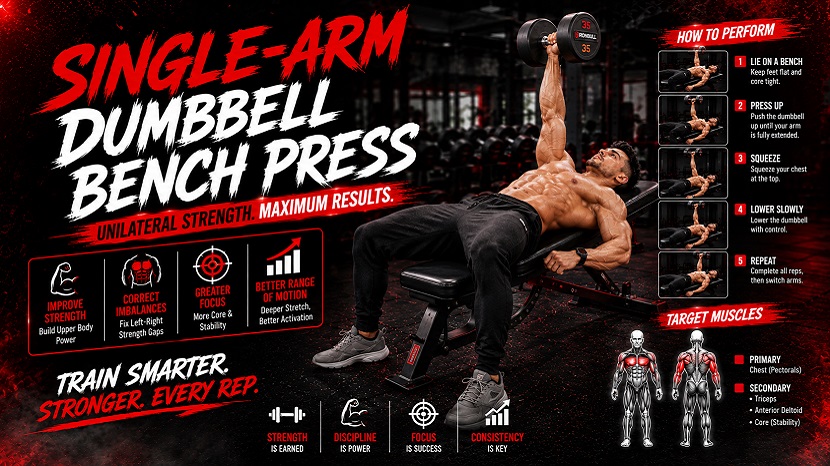
- How to Do the Single Arm Dumbbell Bench Press: Step-by-Step
- Common Mistakes and How to Fix Them
- Single Arm Dumbbell Bench Press vs Regular Dumbbell Bench Press
- Effective Variations of the Single Arm Dumbbell Press
- Programming Tips and Sets and Reps
- Sample Chest Workout Including Single Arm Dumbbell Bench Press
- Safety Tips and Who Should Be Careful
- Progressions for Beginners to Advanced Lifters
- Final Thoughts
- FAQs
What Is the Single Arm Dumbbell Bench Press?
The single arm dumbbell bench press is a unilateral pressing movement performed while lying on a flat bench. You hold one dumbbell in one hand and press it upward while keeping your body stable. The non-working arm usually stays extended or rests lightly on your chest or side.
This exercise belongs to the family of unilateral dumbbell bench press variations. It creates an offset load that forces your core and shoulder stabilizers to work hard against rotation. Many people also call it the single arm bench press or single arm chest press exercise.
Because only one side moves at a time, the single arm dumbbell press form reveals strength differences between your left and right sides. This makes it an excellent diagnostic tool and corrective exercise.
Muscles Worked by the Single Arm Dumbbell Bench Press
This movement targets several muscle groups at once:
- Pectoralis major (both sternal and clavicular heads) – primary movers during the press
- Anterior deltoids – assist in shoulder flexion and stability
- Triceps brachii – extend the elbow at the top of the movement
- Core muscles (obliques, rectus abdominis, transverse abdominis) – resist rotation and maintain a stable torso
- Upper back and scapular stabilizers – keep the shoulder blade pinned in the correct position
The single arm dumbbell chest press also recruits smaller stabilizing muscles around the shoulder joint more than a two-arm version. This extra demand improves shoulder health and pressing power over time.
Benefits of Single Arm Dumbbell Bench Press
The benefits of single arm dumbbell bench press go far beyond simple chest development.
First, it builds serious anti-rotation strength. When you press with one arm, your body wants to twist toward the loaded side. Your core must brace hard to keep your hips and shoulders square. This functional stability transfers to sports, daily activities, and heavier bilateral lifts.
Second, it helps correct muscle imbalances. Most people have a stronger dominant side. The single arm dumbbell bench press lets you give the weaker side extra attention so both sides develop evenly.
Third, it improves pressing skill and mechanics. The stability demands teach you how to create full-body tension. Many powerlifters use the single arm bench press as a warm-up or accessory to groove better barbell bench press technique.
Fourth, it offers a safer way to train close to failure. Because the load is lighter than a two-arm dumbbell bench press, you can focus on control without needing a spotter as often.
Fifth, it adds variety to chest workouts. Doing the same bilateral movements every session can lead to plateaus. Adding the single arm dumbbell chest press provides a new stimulus that keeps progress moving forward.
Finally, it strengthens the mind-muscle connection. With only one arm working, you can really feel the chest contracting through the full range of motion.
How to Do the Single Arm Dumbbell Bench Press: Step-by-Step
Follow these steps for safe and effective single arm dumbbell press form.
- 1. Lie on a flat bench with your feet planted firmly on the floor. Keep your butt, upper back, and head in contact with the bench at all times. This creates five points of contact for maximum stability.
- 2. Hold a dumbbell in one hand with a neutral or slightly pronated grip. Start with the dumbbell at chest level or just above it. Your non-working arm can stay extended straight up or rest on your lower ribs.
- 3. Brace your core as if someone is about to punch you in the stomach. Squeeze your glutes and drive your feet into the floor. Pin your working-side shoulder blade down and back.
- 4. Take a deep breath and brace. Lower the dumbbell in a controlled manner until your upper arm is roughly parallel to the floor or your elbow reaches about 45 degrees below shoulder level. Keep your wrist straight and elbow under the dumbbell.
- 5. Press the dumbbell upward in a slight arc toward the midline of your body. Exhale as you press. Keep your shoulder blade pinned and resist any twisting of your torso.
- 6. Lock out your elbow at the top without hyperextending. Pause briefly and feel the chest contraction.
- 7. Lower again under control. Complete all reps on one side before switching.
- 8. Always start with your weaker or non-dominant side. Match the reps on the stronger side to the number you achieved on the weaker side.
Pro tip: Keep the non-working arm extended or actively braced. This helps maintain even shoulder positioning and increases overall stability.
Common Mistakes and How to Fix Them
Even experienced lifters make errors with the single arm dumbbell bench press. Here are the most frequent ones and their fixes.
- Excessive torso rotation – Your body twists toward the pressing arm. Fix: Brace harder and drive the opposite foot into the floor. Think about screwing your shoulder blade into the bench.
- Shoulder rolling forward – The working shoulder pops up at the bottom. Fix: Keep the shoulder blade pinned down and back throughout the entire set. Use a lighter weight until the pattern feels natural.
- Flaring the elbow too wide – This stresses the shoulder. Fix: Keep the elbow at about 45 degrees from your torso at the bottom position.
- Using momentum or bouncing – The dumbbell bounces off the chest. Fix: Lower slowly for a three-second count and pause at the bottom.
- Lifting the hips off the bench – This reduces stability and can strain the lower back. Fix: Keep your butt glued to the bench and maintain a slight natural arch in the lower back.
- Incomplete range of motion – You only do partial reps. Fix: Lower until the upper arm is parallel to the floor unless mobility limits you.
- Gripping too tightly or letting the wrist bend – This wastes energy and risks wrist strain. Fix: Maintain a firm but neutral wrist position aligned with the forearm.
Single Arm Dumbbell Bench Press vs Regular Dumbbell Bench Press
Here is a clear comparison:
| Aspect | Single Arm Dumbbell Bench Press | Regular (Bilateral) Dumbbell Bench Press |
|---|---|---|
| Load per arm | Lower (usually 40-60% of bilateral weight) | Higher total load |
| Core demand | Very high (anti-rotation) | Moderate |
| Imbalance correction | Excellent | Limited |
| Stability requirement | High | Moderate |
| Best for | Skill, core strength, fixing weak sides | Maximum chest hypertrophy and strength |
| Equipment needed | One dumbbell and bench | Two dumbbells and bench |
| Spotter requirement | Lower (easier to bail) | Higher for heavy sets |
The single arm dumbbell bench press does not replace the regular dumbbell bench press. It complements it. Use both in your chest workout program for complete development.
Effective Variations of the Single Arm Dumbbell Press
Once you master the basic movement, try these variations:
- Single arm incline dumbbell bench press – Targets the upper chest more.
- Single arm floor press – Reduces shoulder stress and limits range of motion. Great for beginners or those with shoulder issues.
- Single arm dumbbell floor press with rotation control – Add a slight pause at the bottom to increase time under tension.
- Alternating single arm dumbbell bench press – Press one arm while the other holds the top position. Increases time under tension for the core.
- Single arm bottoms-up kettlebell press – Increases grip and shoulder stability demands dramatically.
Programming Tips and Sets and Reps
For most people, perform the single arm dumbbell bench press 2–3 times per week as part of a chest or upper body day.
- For strength and stability: 3–4 sets of 6–8 reps per arm with moderate to heavy weight. Rest 2–3 minutes between arms or sets.
- For hypertrophy and control: 3–4 sets of 8–12 reps per arm. Use a 3-second lowering phase.
- As a warm-up or finisher: 2–3 sets of 10–15 reps with lighter weight and perfect form.
Always start sets with the weaker side. This prevents the stronger side from masking imbalances.
Sample Chest Workout Including Single Arm Dumbbell Bench Press
Here is a balanced chest workout you can use once or twice per week:
- Flat dumbbell bench press – 4 sets of 6–8 reps
- Single arm dumbbell bench press – 3 sets of 8–10 reps per arm (start with weaker side)
- Incline dumbbell press – 3 sets of 8–10 reps
- Cable chest fly or pec deck – 3 sets of 12–15 reps
- Push-ups or close-grip push-ups – 2–3 sets to near failure
Rest 60–90 seconds between most sets. Take longer rests (2+ minutes) on the heavier compound movements.
Safety Tips and Who Should Be Careful
The single arm dumbbell bench press is generally safe when performed with good form. However, take these precautions:
- Start with very light weight to groove the pattern.
- Use a spotter or safety pins if you plan to go heavy.
- Avoid if you have acute shoulder pain or instability. Consult a doctor or physical therapist first.
- Keep the dumbbell under control at all times. Never let it drift outward or backward.
- Breathe properly: brace on the way down and exhale forcefully on the press.
People with significant shoulder injuries or recent surgeries should get clearance before trying unilateral pressing variations.
Progressions for Beginners to Advanced Lifters
Beginners: Master the movement with very light dumbbells or even a water bottle. Focus on keeping the torso completely still. Perform on the floor first if a bench feels unstable.
Intermediate: Add pauses at the bottom or slow the eccentric phase to three or four seconds. Increase weight gradually while maintaining perfect single arm dumbbell press form.
Advanced: Use heavier loads, add chains or bands for accommodating resistance, or combine with other unilateral work such as single-arm landmine presses. Track left versus right side strength and aim to close any gaps.
Final Thoughts
The single arm dumbbell bench press delivers far more than a simple chest pump. It builds functional strength, improves stability, and helps create balanced development that supports long-term progress in every pressing movement.
Whether your goal is a bigger chest, stronger bench press, or better core control, adding this single arm chest press exercise to your routine pays dividends. Focus first on mastering how to do single arm dumbbell bench press with textbook form. Then gradually increase load and explore the many benefits of single arm dumbbell bench press in your own training.
Train smart, stay consistent, and enjoy the steady gains that come from smart unilateral work. Your chest, shoulders, and core will thank you.
Frequently Asked Questions (FAQs)
1. What is the single-arm dumbbell bench press?
Answer: The single-arm dumbbell bench press is a unilateral chest exercise performed while lying on a flat bench. You press one dumbbell upward using only one arm at a time while keeping your body stable. This movement builds chest strength, improves core stability, and helps identify and correct strength differences between your left and right sides.
2. How do you perform the single-arm dumbbell bench press with correct form?
Answer: Lie flat on a sturdy bench with your feet planted firmly on the floor. Hold a dumbbell in one hand at chest level with your palm facing forward. Brace your core, pull your shoulder blades back and down, and press the dumbbell straight up until your arm is fully extended without locking the elbow. Lower the weight slowly and with full control over 2–3 seconds. Keep your hips and shoulders square on the bench and avoid twisting your torso. Complete all repetitions on one side before switching arms.
3. What muscles does the single-arm dumbbell bench press target?
Answer: This exercise primarily targets the pectoralis major (the large chest muscle). It also strongly engages the anterior deltoids (front shoulders), triceps brachii, and several core muscles including the obliques and rectus abdominis that work to stabilize your body and prevent rotation during the one-arm movement.
4. What are the main benefits of the single-arm dumbbell bench press?
Answer: The single-arm dumbbell bench press builds balanced chest muscle, strengthens core stability and anti-rotational strength, corrects left-to-right muscle imbalances, improves mind-muscle connection, and often allows a greater range of motion than barbell pressing. It also develops functional strength that carries over well to sports and daily activities.
5. Is the single-arm dumbbell bench press good for beginners?
Answer: Yes, the single-arm dumbbell bench press is excellent for beginners. It allows you to learn the pressing movement pattern on one side at a time without the coordination demands of two arms. Start with very light dumbbells, focus on slow controlled repetitions, and prioritize perfect form. Many beginners develop better chest activation and stability with this exercise compared to traditional barbell bench press.
6. How many sets and reps should beginners and intermediate lifters aim for?
Answer: For muscle growth, perform 3 to 4 sets of 8 to 12 repetitions per arm. Beginners should start with 2 to 3 sets of 10 to 15 reps using a weight that challenges you while maintaining perfect technique. Rest 60–90 seconds between sets. As you progress, gradually increase the dumbbell weight or add advanced techniques such as slower lowering phases or brief pauses.
7. How does the single-arm dumbbell bench press help with muscle imbalances?
Answer: Because each arm works completely independently, the weaker side cannot rely on the stronger side for help. Over time, the weaker arm is forced to develop equally, leading to more balanced strength and muscle size on both sides. This reduces injury risk and creates more symmetrical chest development that bilateral exercises often miss.
8. What are common mistakes people make during the single-arm dumbbell bench press?
Answer: Common mistakes include twisting the torso to lift the weight, using momentum instead of controlled muscle power, letting the elbow flare out wide, failing to keep shoulder blades retracted, and rushing through the lowering phase. Fix these by bracing your core tightly, keeping your body flat and square on the bench, maintaining a 45-degree elbow angle, and taking 2–3 seconds to lower the dumbbell with full control.
9. Is the single-arm dumbbell bench press safe if I have shoulder problems?
Answer: If you have shoulder pain or previous injuries, consult a doctor or physical therapist before performing this exercise. When done with proper form and appropriate weight, it can strengthen shoulder stabilizers. Safer modifications include the single-arm dumbbell floor press (which limits range of motion) or using a neutral grip. Stop immediately if you feel sharp pain and never prioritize weight over technique.
10. What are some variations and ways to progress the single-arm dumbbell bench press?
Answer: Effective variations include the incline single-arm dumbbell bench press for upper chest emphasis, the single-arm floor press for shoulder-friendly training, and paused repetitions to increase time under tension. Progress by gradually increasing weight, slowing the lowering phase, adding a 2–3 second pause at the bottom, performing on a stability ball for extra core challenge, or supersetting with push-ups or regular bench press.