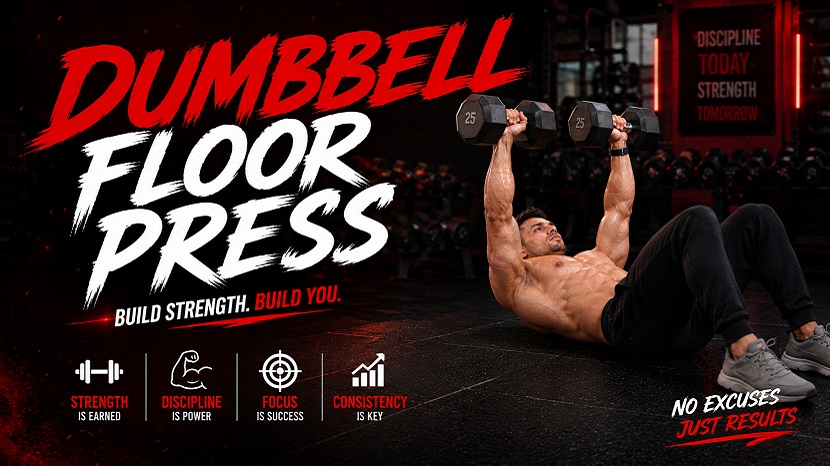
The dumbbell floor press stands out as one of the most effective and accessible pressing movements for building upper body strength. Whether you train at home or in a gym, this exercise delivers serious results for the chest, triceps, and shoulders while placing less stress on the joints than traditional pressing variations. It requires only a pair of dumbbells and a flat surface, making it ideal for anyone looking to improve pressing power without a bench.
Many lifters discover that mastering the floor press exercise helps break through plateaus in other lifts. The limited range of motion forces you to generate force from a dead stop, which builds explosive strength and reinforces proper mechanics. This guide covers everything you need, from the basics to advanced programming tips, so you can perform the movement safely and effectively.
Contents Overview
- What Is the Dumbbell Floor Press
- Muscles Worked in the Dumbbell Floor Press
- Dumbbell Floor Press Benefits for Strength and Muscle Growth
- How to Do the Dumbbell Floor Press Step by Step
- Essential Dumbbell Floor Press Form Tips
- Common Mistakes to Avoid During the Floor Press Exercise
- Dumbbell Floor Press vs Bench Press: Key Differences
- Variations to Enhance Your Chest Workout Dumbbell Floor Press
- How to Add the Dumbbell Floor Press to Your Training Program
- Safety Precautions and Final Thoughts
- FAQs
What Is the Dumbbell Floor Press
The dumbbell floor press is a compound pushing exercise performed while lying flat on the floor. Unlike a bench press, your upper arms make contact with the ground at the bottom of each repetition. This simple change dramatically alters the mechanics and benefits of the movement.
Because the floor stops your elbows from dropping below a certain point, the exercise removes the deep stretch at the bottom. This makes it friendlier on the shoulders for many people while shifting more emphasis toward the triceps and the mid-to-top portion of the press. It serves as an excellent standalone chest workout or as a complementary movement to build lockout strength.
People often search for a dumbbell floor press tutorial because the setup feels different from what they expect. Once you learn the proper positioning and control, the exercise becomes straightforward and highly effective for home training sessions.
Muscles Worked in the Dumbbell Floor Press
The floor press exercise primarily targets the triceps brachii. The limited range of motion means the triceps handle a larger portion of the load, especially during the lockout phase. This makes the movement one of the best choices when you want to develop stronger, more defined arms.
The pectoralis major in the chest still works hard, particularly when you focus on squeezing the dumbbells together at the top of each rep. The anterior deltoids in the front of the shoulders assist throughout the movement. Your core muscles, including the abs and obliques, stay engaged to keep your lower back stable and prevent excessive arching.
Secondary stabilizers around the shoulder blades and wrists also activate to maintain control. Because each arm moves independently with dumbbells, the exercise helps correct strength imbalances between sides. This balanced development carries over to better performance in daily activities and other lifts.
Dumbbell Floor Press Benefits for Strength and Muscle Growth
One of the biggest dumbbell floor press benefits is improved shoulder safety. By shortening the range of motion, the exercise reduces stress on the shoulder joints and the pectoralis minor. Lifters who experience discomfort during full bench presses often find this variation much more comfortable.
The movement builds exceptional lockout strength. Many people struggle at the top of bench presses or overhead presses. Training the triceps dumbbell floor press strengthens exactly that sticking point, leading to smoother and stronger performances in other compound lifts.
Because you press from a complete stop with no momentum from the bottom, the exercise develops pure concentric power. This quality transfers well to sports and functional activities. It also serves as an outstanding option for a home chest workout with dumbbells when you lack access to a bench or prefer training in a smaller space.
Hypertrophy gains come from the constant tension and the ability to control the eccentric lowering phase. Squeezing the chest at the top adds an extra peak contraction that many lifters miss in longer-range movements. Over time, this combination produces noticeable size and definition in both the chest and triceps.
How to Do the Dumbbell Floor Press Step by Step
Learning how to do dumbbell floor press correctly starts with proper setup. Follow these steps for safe and effective execution.
- Step 1: Sit on the floor with your legs extended or knees bent. Place a pair of dumbbells on the floor beside your hips or rest them upright on your thighs.
- Step 2: Grip the dumbbells firmly with palms facing forward or slightly angled. Brace your core and roll backward slowly until your upper back, shoulders, and head rest flat on the floor. Keep the dumbbells close to your chest during this transition.
- Step 3: Bend your knees and place your feet flat on the floor about hip-width apart. This position provides stability and protects your lower back.
- Step 4: Press the dumbbells upward until your arms reach full extension directly above your shoulders. Do not let the weights touch or collide at the top.
- Step 5: Lower the dumbbells with control until your triceps and upper arms make light contact with the floor. Keep your elbows at approximately a 45-degree angle to your torso.
- Step 6: Pause briefly at the bottom, then drive the weights back up by extending your elbows and squeezing your chest. Repeat for the desired number of repetitions.
- Step 7: After your final rep, bring the dumbbells back to your chest, sit up using your core, and place the weights safely on the floor beside you.
Start with lighter weights to master the pattern before progressing. Focus on smooth, controlled movement rather than rushing through the sets.
Essential Dumbbell Floor Press Form Tips
Proper dumbbell floor press form determines how much benefit you receive and how safe the exercise feels. Keep these cues in mind during every session.
- Maintain a neutral wrist position. Avoid letting the dumbbells tilt too far forward or backward, as this can strain the wrists and elbows.
- Keep your shoulder blades pulled down and back against the floor. This creates a stable base and protects the shoulder joints.
- Breathe in as you lower the weights and exhale forcefully as you press upward. Controlled breathing helps maintain core tension.
- Stop just short of full elbow lockout at the top to keep constant tension on the working muscles. This technique enhances muscle growth.
- Press the dumbbells slightly inward toward the midline of your body at the top. This adduction movement increases chest activation significantly.
- Keep your glutes and lower back in contact with the floor throughout the set. Avoid excessive arching, which reduces effectiveness and increases injury risk.
Filming your sets from the side can help you check these points. Small adjustments in form often lead to big improvements in both strength and comfort.
Common Mistakes to Avoid During the Floor Press Exercise
Even experienced lifters sometimes make errors with the floor press exercise. Avoiding these mistakes will help you get better results and stay injury-free.
- Bouncing the elbows off the floor: This creates unnecessary joint stress and reduces muscle engagement. Always lower with control and pause lightly at the bottom.
- Flaring the elbows out wide: Keep elbows at roughly 45 degrees to protect the shoulders. Wide elbows shift stress away from the triceps and chest.
- Using momentum or arching the back: Keep your core braced and glutes down. Excessive arching turns the movement into something closer to a bench press and defeats the purpose.
- Letting the dumbbells collide at the top: This can destabilize the shoulders. Maintain a small gap between the weights throughout the set.
- Choosing weights that are too heavy too soon: Poor form with heavy loads leads to injury. Master the pattern with moderate weights first.
- Neglecting the squeeze at the top: Failing to contract the chest and triceps at the peak reduces hypertrophy potential. Focus on a strong mind-muscle connection.
Correcting these issues usually produces faster progress than simply adding more weight. Quality always beats quantity in the long run.
Dumbbell Floor Press vs Bench Press: Key Differences
Understanding the dumbbell floor press vs bench press helps you decide when to use each movement. Both exercises build pressing strength, yet they offer distinct advantages.
| Aspect | Dumbbell Floor Press | Bench Press |
|---|---|---|
| Range of Motion | Limited by the floor; stops at upper arm contact | Full range; allows deep stretch at bottom |
| Equipment Needed | Dumbbells and floor space only | Bench, rack, and usually a spotter for heavy sets |
| Shoulder Stress | Lower due to shorter range | Higher, especially with poor form or mobility issues |
| Triceps Emphasis | High, especially in lockout phase | Moderate; depends on grip and technique |
| Chest Activation | Good with focused squeeze; less stretch-mediated growth | Higher potential for overall chest development |
| Home Training | Excellent choice for minimal equipment | Requires a bench, less practical at home |
| Best For | Lockout strength, shoulder-friendly training, triceps focus | Maximum chest hypertrophy, overall pressing power |
Many smart programs use both movements. Perform the dumbbell floor press on days when shoulders feel sensitive or when you want extra triceps work. Save the bench press for sessions focused on maximum chest development.
Variations to Enhance Your Chest Workout Dumbbell Floor Press
Once you master the basic movement, try these variations to keep your chest workout dumbbell floor press sessions fresh and challenging.
- Single-Arm Dumbbell Floor Press: Press one dumbbell at a time while keeping the opposite arm extended or resting on your abdomen. This variation increases core demand and helps fix left-right imbalances.
- Dead-Stop Dumbbell Floor Press: Lower the weights until they rest completely on the floor for a full second before pressing. This eliminates any stretch reflex and builds starting strength.
- Glute Bridge Floor Press: Lift your hips into a bridge position while pressing. The added glute and core engagement increases overall body tension and stability.
- Neutral Grip Floor Press: Turn your palms to face each other. This grip often feels more shoulder-friendly and changes the emphasis slightly toward the inner chest.
- Slow Eccentric Floor Press: Take three to four seconds to lower each repetition. The extended time under tension accelerates muscle growth.
Rotate variations every four to six weeks. This approach prevents boredom and continues stimulating new adaptations in the chest, triceps, and shoulders.
How to Add the Dumbbell Floor Press to Your Training Program
Incorporating the dumbbell floor press into your routine depends on your goals. For general strength and muscle building, perform 3 to 4 sets of 8 to 12 repetitions. Rest 90 to 120 seconds between sets to maintain quality.
If your main goal is triceps development and lockout power, use slightly heavier weights for 4 to 6 sets of 5 to 8 reps. Focus on controlled lowering and explosive yet smooth pressing.
Place the exercise early in your workout when you are fresh, or use it as a finisher after heavier compound movements. It pairs well with push-up variations, overhead presses, and rowing exercises for balanced upper body development.
Beginners should start with two sessions per week and focus on form. Intermediate and advanced lifters can include it three times weekly as part of different training splits. Always warm up with lighter sets and mobility work for the shoulders and thoracic spine.
Track your progress by noting the weights used and how the movement feels. Gradual increases in load or repetitions over time indicate improving strength and technique.
Safety Precautions and Final Thoughts on This Triceps Dumbbell Floor Press
Safety should always come first with any pressing movement. Choose dumbbells you can control throughout the entire set. If the weights feel too heavy to set up safely, reduce the load or ask for assistance during the initial positioning.
Listen to your body. Sharp pain in the shoulders, elbows, or wrists signals that you should stop and reassess your form or load. Mild muscle fatigue is normal; joint pain is not. Consult a qualified professional if you have pre-existing shoulder or elbow issues before starting.
The dumbbell floor press offers an outstanding balance of effectiveness and joint friendliness. It delivers impressive dumbbell floor press benefits for strength, muscle growth, and pressing performance while remaining accessible for home training. Whether you are a beginner building foundational strength or an experienced lifter looking to refine lockout power, this exercise deserves a regular place in your program.
Commit to practicing proper dumbbell floor press form on every rep. Over time you will notice stronger presses, better muscle definition in the chest and triceps, and greater confidence in your training. Start today with controlled sets and watch your upper body strength improve steadily.
Frequently Asked Questions (FAQs)
1. What is the dumbbell floor press exercise?
Answer: The dumbbell floor press is a compound pressing movement performed while lying flat on the floor instead of a bench. You press a pair of dumbbells upward from a position where your upper arms and triceps make contact with the ground at the bottom of each rep. This limited range of motion makes it an excellent chest workout exercise that builds strength while reducing stress on the shoulders compared to traditional bench pressing.
2. How do you perform the dumbbell floor press with proper form?
Answer: To master dumbbell floor press form, sit on the floor with dumbbells resting on your thighs. Roll backward while keeping the weights close to your chest until your upper back is flat on the ground. Press the dumbbells up until your arms are fully extended, then lower them slowly with control until your triceps lightly touch the floor. Keep your elbows at about a 45-degree angle to your torso, brace your core, and squeeze your chest at the top of each repetition.
3. What muscles does the dumbbell floor press work?
Answer: The dumbbell floor press primarily targets the triceps brachii, pectoralis major in the chest, and anterior deltoids in the shoulders. Because of the shortened range of motion, it places greater emphasis on the triceps for lockout strength. Your core muscles also engage to stabilize your body and maintain a neutral spine throughout the movement.
4. What are the main benefits of the dumbbell floor press?
Answer: The dumbbell floor press benefits include improved lockout strength, reduced shoulder joint stress, and greater accessibility for home training since no bench is required. It helps build muscle in the chest and triceps while teaching better pressing mechanics. Many lifters use it to safely overcome plateaus in their bench press and develop stronger, more stable shoulders.
5. Is the dumbbell floor press good for beginners?
Answer: Yes, the dumbbell floor press is one of the best pressing exercises for beginners. The floor naturally limits how far you can lower the weights, providing built-in safety and reducing injury risk. It teaches proper pressing mechanics with less shoulder strain. Beginners should start with light dumbbells, focus on controlled movement, and perform 3 sets of 10-12 reps to build confidence and strength.
6. Dumbbell floor press vs bench press: which is better?
Answer: When comparing dumbbell floor press vs bench press, the floor press offers a shorter range of motion that is more shoulder-friendly and places greater emphasis on the triceps. The bench press allows a deeper stretch for potentially greater chest growth but requires more equipment and carries higher shoulder stress. The best approach is to include both movements in your program for balanced upper body development.
7. How many sets and reps should I do for the dumbbell floor press?
Answer: For most training goals, perform 3 to 4 sets of 8 to 12 repetitions. Beginners can start with 3 sets of 10-12 reps using moderate weights to master dumbbell floor press form. Intermediate and advanced lifters may use heavier weights for 4-6 reps to build strength or slow the lowering phase for increased muscle tension and growth.
8. What are the best variations of the dumbbell floor press?
Answer: Effective variations include the single-arm dumbbell floor press for fixing strength imbalances and building core stability, the dead-stop version for developing explosive power from a complete pause, and the neutral grip floor press for greater shoulder comfort. Adding a glute bridge during the press increases full-body tension and makes the movement more challenging for intermediate and advanced trainees.
9. Can the dumbbell floor press help improve my bench press?
Answer: Yes, the dumbbell floor press is an excellent accessory exercise for improving bench press performance. It strengthens the lockout phase, builds starting strength from a dead stop, and reinforces scapular stability. Many powerlifters and strength athletes include it regularly to break through plateaus and develop more powerful pressing mechanics.
10. What common mistakes should I avoid when doing the dumbbell floor press?
Answer: Common mistakes include bouncing the elbows off the floor, flaring the elbows too wide, using an excessive lower back arch, and selecting weights that are too heavy. Always lower the dumbbells with full control, keep elbows at roughly 45 degrees to protect the shoulders, and focus on a strong chest squeeze at the top. Avoiding these errors will help you get better results and prevent injuries.