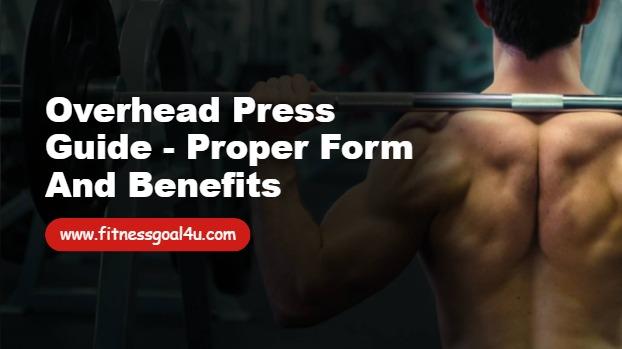
The overhead press, also known as the military press or strict press, is a fundamental compound exercise that involves pressing a weight from shoulder height to overhead while standing. It is one of the most effective movements for building strong, muscular shoulders and upper body pressing strength.
It can be performed with a barbell (most common), dumbbells, kettlebells, or machines. The standing barbell version is considered the classic form and requires significant core and leg stability to maintain a strict, no-momentum execution.
How to Perform the Overhead Press (Step-by-Step Technique)
Strict form is essential to maximize shoulder development and protect the lower back and joints.
- Stand with feet hip-width apart, barbell resting on your upper chest/shoulders (front rack position), hands slightly wider than shoulder-width, palms facing forward.
- Brace your core tightly, squeeze your glutes, and keep your ribs down to maintain a neutral spine.
- Slightly tilt your head back to create clearance for the bar to pass your chin.
- Press the bar straight up by extending your elbows, driving through your heels and keeping the bar path vertical over the mid-foot.
- Lock your arms fully overhead with biceps close to your ears, but avoid hyperextending your elbows.
- Lower the bar under control back to the starting position at your collarbone, tucking your chin slightly to let the bar pass.
- Repeat while maintaining full-body tension—no leg drive or excessive back arching.
For dumbbell variation, start with weights at shoulder height and press straight up, keeping palms facing forward throughout.
Why Do the Overhead Press? (Benefits)
This foundational lift offers numerous advantages for strength and aesthetics:
- Builds strong, rounded shoulders: Primarily targets all three heads of the deltoid (anterior, medial, posterior) for complete development.
- Increases upper body pressing strength: Directly improves performance in bench press, push-ups, and other overhead movements.
- Develops core stability: Standing version forces the abs, obliques, and lower back to stabilize against the overhead load.
- Improves posture and shoulder health: Strengthens scapular stabilizers and promotes better overhead mobility when done correctly.
- Functional carryover: Mimics real-life overhead lifting tasks and enhances athletic performance.
- Boosts overall strength: As a compound lift, it recruits triceps, upper traps, and legs for stability, burning more calories.
- Versatile progression: Easy to scale with barbell, dumbbells, or variations for all levels.
Recommended Sets and Repetitions
Choose volume based on your primary training goal.
| Goal | Sets | Reps | Rest Between Sets |
|---|---|---|---|
| Strength | 4-6 | 3-6 | 2-4 minutes |
| Hypertrophy (Muscle Growth) | 3-5 | 8-12 | 90-120 seconds |
| Endurance & Technique | 3-4 | 12-15 | 60-90 seconds |
Perform 1-2 times per week, ideally early in your shoulder or push workout when fresh.
FAQ (Frequently Asked Questions)
1. Is the overhead press the same as the military press?
Answer: Yes, they are essentially the same exercise. "Military press" is the older term emphasizing strict form (feet together, no leg drive), while "overhead press" is the modern, more general name.
2. Should I lock out my elbows at the top?
Answer: Yes, a controlled lockout is safe and expected. Avoid forcefully hyperextending—finish with arms straight but elbows soft.
3. What muscles does the overhead press primarily work?
Answer: Anterior and medial deltoids, triceps, and upper trapezius are the main movers. Core, lower back, and legs act as stabilizers.
4. Can I do the overhead press seated?
Answer: Yes, seated versions allow heavier loads and stricter shoulder isolation. Standing engages more core and is generally more functional.
5. Why does my lower back hurt during overhead press?
Answer: Excessive back arching (overextension) is the usual cause. Brace your core, squeeze glutes, and keep ribs down to maintain a neutral spine.
6. How often should I train overhead press?
Answer: 1-2 times per week is optimal for most people. Advanced lifters may train it 2-3 times with varied intensity.
7. Barbell or dumbbells for overhead press?
Answer: Barbell allows heavier loads and is best for strength. Dumbbells offer freer range of motion, better balance, and help fix imbalances.
8. Is overhead press safe if I have shoulder pain?
Answer: It depends on the cause. If you have impingement or rotator cuff issues, consult a professional. Many can do it pain-free with proper form and warm-up.