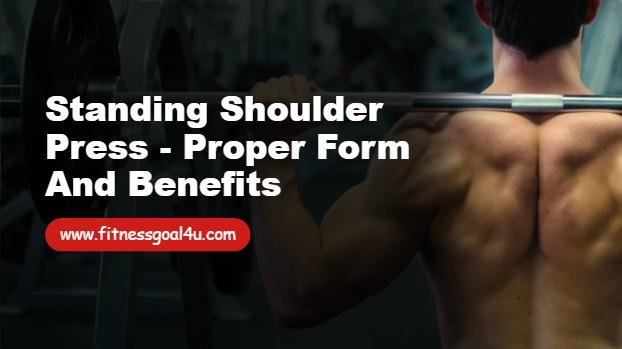
The standing shoulder press, also known as the overhead press or military press, is a classic compound exercise that primarily targets the shoulders. It involves pressing a weight overhead from shoulder height while standing upright.
This movement can be performed with a barbell or dumbbells. The standing variation engages more stabilizing muscles compared to seated versions, making it a full-body challenge. It is a foundational exercise for building upper body strength and is popular in strength training, bodybuilding, and functional fitness programs.
How to Perform the Standing Shoulder Press (Step-by-Step Technique)
Proper form is essential to maximize benefits and prevent injury. Here are detailed steps for both barbell and dumbbell variations.
Barbell Standing Shoulder Press
- Stand with feet shoulder-width apart for stability.
- Grip the barbell slightly wider than shoulder-width, palms facing forward.
- Unrack the bar at shoulder height, resting it on your upper chest or front deltoids.
- Brace your core, squeeze your glutes, and keep your spine neutral.
- Press the bar straight overhead until your arms are fully extended (but not locked).
- Slightly tuck your chin to allow the bar to pass your face.
- Lower the bar slowly back to shoulder height under control.
- Repeat for the desired repetitions.
Dumbbell Standing Shoulder Press
- Stand with feet shoulder-width apart.
- Hold a dumbbell in each hand at shoulder height, palms facing forward (or neutral for variation).
- Brace your core and keep a slight bend in your knees.
- Press the dumbbells overhead until arms are extended, bringing them close at the top without clanging.
- Lower the dumbbells slowly back to shoulder level.
- Repeat smoothly.
Avoid arching your lower back or using momentum from your legs. Breathe in before lowering and exhale on the press.
Why Do the Standing Shoulder Press? (Benefits)
This exercise offers numerous advantages, especially when performed standing:
- Builds shoulder strength and size: Primarily targets the anterior and lateral deltoids for broader, stronger shoulders.
- Engages the core: Requires significant stabilization, improving overall core strength and posture.
- Full-body involvement: Recruits triceps, upper chest, traps, and even legs for balance.
- Functional strength: Mimics real-life overhead lifting, enhancing daily activities and athletic performance.
- Increased calorie burn: Standing variation raises heart rate more than seated, aiding fat loss.
- Better balance and stability: Challenges coordination and reduces injury risk in other lifts.
- Compound movement efficiency: Works multiple muscle groups at once for effective workouts.
Compared to the seated shoulder press, the standing version promotes greater overall strength and core activation, though it may limit the weight used due to balance demands.
Recommended Sets and Repetitions
Reps depend on your goals:
| Goal | Sets | Reps | Rest Between Sets |
|---|---|---|---|
| Strength | 3-5 | 4-6 | 2-5 minutes |
| Hypertrophy (Muscle Growth) | 3-4 | 8-12 | 60-90 seconds |
| Endurance | 3 | 12-15+ | 45-60 seconds |
Beginners should start lighter to master form. Progress by adding weight when you can complete reps comfortably. Perform 1-2 times per week as part of a shoulder or push day routine.
FAQ (Frequently Asked Questions)
1. Is the standing shoulder press better than the seated version?
Answer: It depends on your goals. Standing engages more core and stabilizer muscles for functional strength, while seated allows heavier weights and better shoulder isolation for hypertrophy.
2. Can beginners do the standing shoulder press?
Answer: Yes, but start with light weights or dumbbells to learn proper form. Focus on stability and avoid heavy loads until comfortable.
3. What muscles does the standing shoulder press work?
Answer: Primarily the deltoids (shoulders), triceps, and upper chest. It also heavily involves the core, traps, and legs for stabilization.
4. How much weight should I use for standing shoulder press?
Answer: Choose a weight that allows good form for your target reps. Beginners often start with 10-20 lb dumbbells per hand or an empty barbell.
5. Will standing shoulder press hurt my back?
Answer: Not if done correctly. Brace your core and avoid arching. If you have back issues, try seated or consult a professional.
6. How often should I do standing shoulder presses?
Answer: 1-2 times per week, allowing recovery. Include in push or shoulder workouts.
7. Dumbbells or barbell for standing shoulder press?
Answer: Both are effective. Dumbbells allow natural movement and fix imbalances; barbell lets you lift heavier for strength.
8. What if I feel shoulder pain during the exercise?
Answer: Stop immediately. Pain may indicate poor form or impingement. Reduce weight, check technique, or see a doctor/physical therapist.