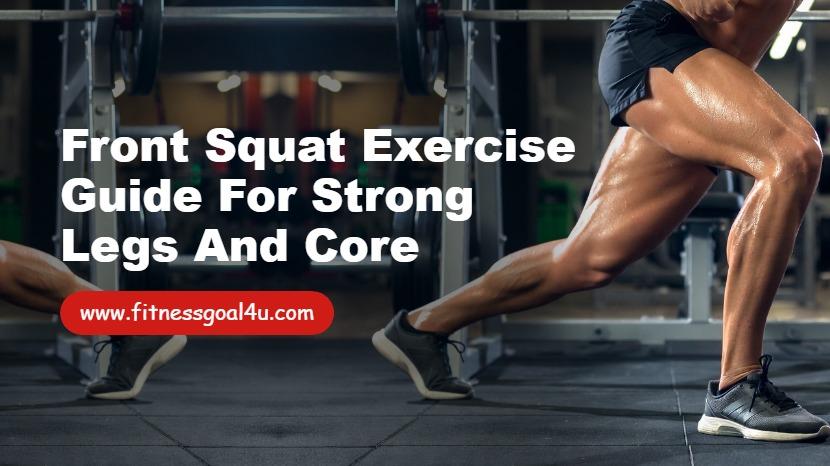
The Front Squat is a powerful lower-body exercise where a barbell is held across the front of the shoulders while performing a squat. Unlike the back squat, the load placement forces an upright torso, making it highly effective for developing the quadriceps, core stability, and upper back strength.
How to Perform the Front Squat (Step-by-Step Technique)
1. Starting Position
Begin by positioning the barbell on the front of your shoulders, resting across the front deltoids. Use either a clean grip or crossed-arm grip to support the bar while keeping your chest lifted.
2. Setup and Stance
Stand with your feet shoulder-width apart, toes slightly pointed outward. Engage your core muscles, brace your abdomen, and maintain a neutral spine before initiating the movement.
3. Descent Phase
Lower your body by bending at the hips and knees simultaneously. Keep your elbows high, chest upright, and weight evenly distributed through your mid-foot and heels.
4. Bottom Position
Descend until your thighs are at least parallel to the floor. Your knees should track in line with your toes, and your torso should remain tall and stable.
5. Ascent Phase
Drive through your heels to return to the starting position. Extend your hips and knees while maintaining core tension and an upright posture throughout the lift.
Why You Should Do Front Squats (Benefits)
The front squat offers unique advantages that make it a valuable addition to any leg workout routine.
- Builds strong and defined quadriceps
- Improves core strength and spinal stability
- Enhances squat mobility and posture
- Reduces lower-back strain compared to back squats
- Transfers well to athletic and functional movements
Recommended Sets and Repetitions
The number of sets and reps depends on your training goal and experience level.
- Beginners: 3 sets of 8–10 repetitions
- Intermediate Lifters: 4 sets of 5–8 repetitions
- Advanced Lifters: 5 sets of 3–5 repetitions
Always prioritize proper technique and controlled movement over lifting heavy weights to maximize results and minimize injury risk.
FAQ ( Frequently Asked Questions)
1. Is the front squat better than the back squat?
Answer: The front squat is not necessarily better, but it emphasizes the quadriceps and core more, while the back squat allows heavier loads and greater overall strength development.
2. Which muscles do front squats work the most?
Answer: Front squats primarily target the quadriceps, while also engaging the glutes, hamstrings, core, and upper back for stabilization.
3. Can beginners do front squats?
Answer: Yes, beginners can perform front squats using lighter weights or goblet squats first to develop mobility and proper form.
4. Why do front squats feel harder?
Answer: Front squats feel harder because the upright posture increases demand on the quadriceps and core while limiting how much weight you can lift.
5. How often should I do front squats?
Answer: Front squats can be performed 1–2 times per week, depending on your overall leg training volume and recovery.