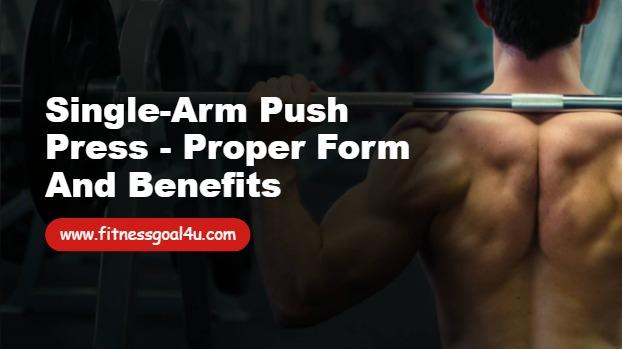
The single-arm push press is a unilateral overhead pressing exercise that combines upper-body strength with explosive lower-body power. Performed with one dumbbell or kettlebell, it involves a quick dip of the legs to generate momentum, followed by a powerful press overhead.
This movement heavily targets the shoulders while improving core stability, coordination, and balance due to the unilateral nature. It is popular in functional fitness, CrossFit, and strength programs for developing athletic power and addressing side-to-side imbalances.
How to Perform the Single-Arm Push Press (Step-by-Step Technique)
Proper coordination between the legs and pressing arm is essential for maximum power and safety.
- Stand with feet shoulder-width apart, holding a dumbbell or kettlebell at shoulder height in one hand, palm facing in or forward.
- Brace your core tightly and keep your non-working hand relaxed or on your hip.
- Perform a quick quarter-squat dip by bending your knees and pushing your hips slightly back—keep your torso upright.
- Explosively extend your hips and knees to drive upward, using the leg momentum to help press the weight overhead.
- Lock your arm fully at the top while keeping your body stable and avoiding excessive lean to the opposite side.
- Lower the weight slowly and under control back to shoulder height, absorbing the descent with a slight knee bend.
- Complete all reps on one side before switching arms.
Breathe out forcefully during the explosive press and inhale during the dip and lowering phase.
Why Do the Single-Arm Push Press? (Benefits)
This powerful variation offers unique advantages:
- Builds explosive power: Combines leg drive with overhead pressing for athletic transfer to sports and functional movements.
- Increases shoulder strength and size: Effectively loads the deltoids and triceps with heavier weight than strict single-arm presses.
- Improves core stability and anti-rotation: Forces the obliques and abs to resist lateral lean, enhancing overall trunk strength.
- Corrects imbalances: Unilateral work identifies and fixes strength differences between left and right sides.
- Enhances coordination and timing: Requires precise leg-arm synchronization for optimal power output.
- Joint-friendly overload: Leg assistance allows heavier pressing with reduced pure shoulder stress.
- Versatile and functional: Mimics real-world unilateral overhead tasks and improves overall athleticism.
Recommended Sets and Repetitions
Use moderate to heavy weight that challenges power without sacrificing form.
| Goal | Sets | Reps per Arm | Rest Between Sets |
|---|---|---|---|
| Power & Strength | 4-5 | 3-6 | 2-3 minutes |
| Hypertrophy | 3-4 | 6-10 | 90-120 seconds |
| Endurance | 3 | 10-12 | 60-90 seconds |
Perform 1-2 times per week early in your shoulder or push workout when explosive power is highest.
FAQ (Frequently Asked Questions)
1. What is the difference between a single-arm push press and a strict press?
Answer: The push press uses leg drive for momentum to lift heavier weights explosively, while the strict press relies solely on upper-body strength with no leg assistance.
2. Dumbbell or kettlebell for single-arm push press?
Answer: Both work well. Dumbbells are more stable and common; kettlebells challenge grip and stability more due to the offset weight.
3. What muscles does the single-arm push press work?
Answer: Primarily the deltoids, triceps, and upper chest. Secondarily, it engages the core (especially obliques), quads, glutes, and stabilizers for balance.
4. Can beginners do the single-arm push press?
Answer: Yes, but master the strict single-arm overhead press and basic push press with both arms first to develop coordination and stability.
5. How much leg drive should I use?
Answer: A quick, shallow quarter-squat dip is enough. Avoid turning it into a jerk—keep the press continuous and controlled.
6. Will this exercise cause shoulder issues?
Answer: When performed with proper form and appropriate weight, it is safe. Avoid if you have existing shoulder instability; start light and prioritize control.
7. How often should I include single-arm push presses?
Answer: 1-2 times per week is sufficient. It is neurologically demanding, so allow recovery between sessions.
8. Should I alternate arms or complete one side first?
Answer: Complete all reps on one side before switching for better focus and power output. Alternating works but may reduce explosive drive.