Contents Overview
- What Is the T-Bench Glute Bridge Fly Exercise?
- Key Benefits of the T-Bench Glute Bridge Fly for Chest Development
- Muscles Targeted by This Compound Chest Exercise
- Step-by-Step Guide: How to Do the T-Bench Glute Bridge Fly
- Essential Form Tips for the Glute Bridge Chest Fly
- Common Mistakes to Avoid with the T-Bench Glute Bridge Fly
- T-Bench Glute Bridge Fly vs Traditional Dumbbell Chest Fly
- Variations and Progressions for the T-Bench Glute Bridge Fly
- How to Add the T-Bench Glute Bridge Fly to Your Chest Workout Routine
- Safety Considerations and Who Should Try This Exercise
- Conclusion
- FAQs
What Is the T-Bench Glute Bridge Fly Exercise?
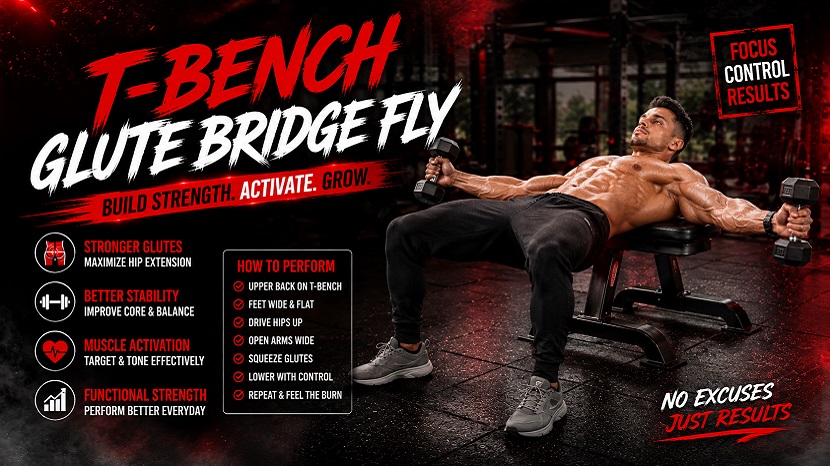
The t-bench glute bridge fly is an innovative dumbbell chest fly variation that combines upper body chest work with lower body stability. Also known as the t bench dumbbell fly or glute bridge chest fly, this movement places your shoulders on a flat bench while your hips rise into a glute bridge position. The setup forms a T-shape with your body, which is where the name originates.
Unlike a standard chest fly performed flat on a bench, this version limits your range of motion in a controlled way. Your elbows stop when they reach the bench surface, similar to a floor fly but with the added benefit of a strong glute bridge exercise underneath. This creates full-body tension that enhances chest contraction while protecting the shoulders.
Many lifters searching for effective inner chest exercises discover that the chest fly with glute bridge delivers a deeper squeeze at the top of each rep. It turns a classic isolation move into one of the smartest compound chest exercises available. Whether you are a beginner learning how to do chest fly safely or an experienced trainee wanting more from your chest day, this exercise offers a fresh approach that builds both aesthetics and functional strength.
Key Benefits of the T-Bench Glute Bridge Fly for Chest Development
The t-bench glute bridge fly stands out because it solves common problems with traditional chest flies. First, it allows you to use heavier dumbbells safely. The bench acts as a natural stopper, so you never overstretch your shoulders at the bottom. This controlled range makes progressive overload easier and more joint-friendly.
Second, the glute bridge exercise component creates full-body tension. When your glutes and core stay tight, your chest works harder. You cannot get lazy with your midsection the way many people do during regular flies. This extra stability often leads to a stronger mind-muscle connection and better inner chest activation.
Third, this movement serves as excellent glute activation exercises during an upper body session. Your glutes, hamstrings, and core stay engaged throughout, turning the exercise into true compound chest exercises that burn more calories and improve overall athleticism. Many people notice improved posture and hip strength after adding it consistently.
Finally, the exercise excels at targeting the inner chest. The horizontal adduction combined with the squeeze at the top creates that sought-after line down the middle of the chest. For anyone focused on inner chest exercises, the glute bridge chest fly often produces better results than flat bench flies alone.
Muscles Targeted by This Compound Chest Exercise
The t-bench glute bridge fly is a multi-muscle movement that delivers more than just chest work. Here are the primary and secondary muscles involved:
| Muscle Group | Role in the Exercise | Why It Matters |
|---|---|---|
| Pectoralis Major (Inner Chest) | Primary mover during the fly and squeeze | Builds that central chest definition many lifters chase |
| Gluteus Maximus | Drives the bridge and maintains hip height | Adds stability and turns the move into compound work |
| Core (Abs and Obliques) | Keeps the body rigid and prevents arching | Improves overall strength transfer and protects the lower back |
| Anterior Deltoids and Triceps | Stabilize the arms and shoulders | Support heavier loads and protect the shoulder joint |
| Hamstrings | Assist in holding the bridge position | Enhance posterior chain engagement for balanced development |
Because the exercise combines chest isolation with glute activation exercises, it trains the body as an integrated unit rather than isolated parts. This is one reason it ranks among the most effective compound chest exercises for both aesthetics and performance.
Step-by-Step Guide: How to Do the T-Bench Glute Bridge Fly
Learning how to do chest fly in the t-bench position takes practice, but the steps are straightforward once you understand the setup. Follow this guide carefully for best results and safety.
Step 1: Grab a pair of dumbbells and sit on the edge of a flat bench. Place the dumbbells on your thighs with palms facing each other.
Step 2: Lie back and position your upper back and shoulders firmly on the bench. Your head and neck should rest comfortably on the bench as well. Let your hips drop slightly at first.
Step 3: Press the dumbbells straight up above your shoulders with a slight bend in your elbows. This is your starting position.
Step 4: Drive your shoulder blades down and back into the bench. Squeeze your glutes hard and lift your hips until your body forms a straight line from knees to shoulders. Keep your pelvis neutral and avoid overarching your lower back.
Step 5: Take a deep breath and brace your core. Slowly lower the dumbbells in a wide arc, keeping the same slight bend in your elbows. Lower with control for about four seconds.
Step 6: Stop the movement when your elbows gently touch the sides of the bench. Do not let the weights rest or bounce.
Step 7: Squeeze your chest hard to bring the dumbbells back up in the same arc motion. Focus on bringing your elbows together at the top rather than pressing the weights straight up.
Step 8: Maintain tension in your glutes and core the entire time. Complete 10 to 12 controlled reps, then rest 60 seconds between sets.
Start with lighter weights than you would use for a regular dumbbell chest fly variation until the position feels natural. Quality of movement matters more than heavy loading in the beginning.
Essential Form Tips for the Glute Bridge Chest Fly
Small details separate a good t-bench glute bridge fly from a great one. Keep these cues in mind every rep.
- Drive your shoulders firmly into the bench before every set. This retracts your shoulder blades and creates a stable base for chest work.
- Keep your elbows slightly bent throughout. Locking them puts unnecessary stress on the joints and reduces chest involvement.
- Maintain a 4-second lowering phase. The slow eccentric creates more muscle damage and growth stimulus in the inner chest.
- Never let your hips sag. If your glutes fatigue, lower the weight or reduce reps rather than breaking form.
- Breathe out powerfully as you squeeze the weights together at the top. This helps create that peak chest contraction.
- Keep your head and neck relaxed on the bench. Do not strain forward to watch the weights.
These tips turn the glute bridge chest fly into a highly effective tool for inner chest exercises while protecting your shoulders and lower back.
Common Mistakes to Avoid with the T-Bench Glute Bridge Fly
Even experienced lifters make errors with this dumbbell chest fly variation. Watch for these issues and correct them quickly.
- Arching the lower back: This happens when glutes are not engaged enough. It reduces glute activation and can strain the spine. Fix it by squeezing glutes harder and keeping ribs down.
- Dropping hips too low: Your body should stay in a straight line. Sagging hips turn the move into a weak position and reduce chest effectiveness.
- Using momentum on the way up: Swinging the weights robs the chest of work. Slow down and focus on a controlled squeeze instead.
- Letting elbows flare out too wide: Keep a consistent slight bend and think about hugging a barrel. This protects shoulders and targets the inner chest better.
- Resting at the bottom: When elbows touch the bench, keep tension in the chest. Do not relax the weights onto your arms.
- Lifting head off the bench: This strains the neck and breaks shoulder stability. Keep your head supported the entire set.
Avoiding these mistakes ensures you get maximum benefit from the t bench dumbbell fly while staying injury-free.
T-Bench Glute Bridge Fly vs Traditional Dumbbell Chest Fly
Understanding the differences helps you choose the right tool for your goals. Here is a clear comparison:
| Aspect | Traditional Dumbbell Chest Fly | T-Bench Glute Bridge Fly |
|---|---|---|
| Range of Motion | Full stretch possible, which can stress shoulders | Limited and controlled by bench contact, much safer |
| Load Potential | Often limited by shoulder comfort | Higher loads possible due to built-in safety stop |
| Core and Glute Involvement | Minimal, easy to go on autopilot | High, turns movement into true compound work |
| Inner Chest Emphasis | Good with proper squeeze | Often superior due to stability and top contraction |
| Best For | Pure isolation and stretch focus | Safe progressive overload, glute activation, and joint-friendly training |
Many people find the t-bench glute bridge fly more enjoyable and effective once they master the position. It solves the biggest complaints about regular flies while adding valuable lower body work.
Variations and Progressions for the T-Bench Glute Bridge Fly
Once you feel comfortable with the basic glute bridge chest fly, try these variations to keep progressing.
- Isometric Squeeze Hold: At the top of each rep, hold the squeeze for 2 to 3 seconds before lowering. This increases time under tension for the inner chest.
- Press-Fly Hybrid: After the fly squeeze, press the dumbbells up like a chest press for one rep, then return to fly position. This adds extra volume and power.
- Single-Arm Version: Perform the movement one arm at a time while keeping the bridge solid. This challenges core stability even more.
- Tempo Variation: Use a 5-second lower and explosive squeeze on the way up. Different tempos create new growth stimulus.
- Feet Elevated Bridge: Place feet on a low step or box to increase glute and hamstring demand. Only try this after mastering the standard position.
These options keep your chest workouts interesting and help you continue making gains with the t-bench glute bridge fly over time.
How to Add the T-Bench Glute Bridge Fly to Your Chest Workout Routine
The t-bench glute bridge fly works best as a finisher rather than a main lift. Place it near the end of your chest session after compound presses.
Sample chest day structure:
- Flat or Incline Dumbbell Press: 4 sets of 6 to 8 reps
- Incline Barbell Press or Machine Press: 3 sets of 8 to 10 reps
- Cable or Machine Fly: 3 sets of 10 to 12 reps
- T-Bench Glute Bridge Fly: 3 to 4 sets of 10 to 12 reps with 60 seconds rest
You can also superset it with a glute-focused move like hip thrusts on lower body days for extra glute activation exercises benefits. Aim to increase weight or reps slightly each week while maintaining perfect form. Most people see noticeable improvements in chest shape and glute strength within 4 to 6 weeks of consistent use.
Safety Considerations and Who Should Try This Exercise
The t-bench glute bridge fly is generally very safe because of the limited range of motion. However, keep these points in mind.
Warm up thoroughly with light sets and arm circles before loading heavy dumbbells. If you have existing shoulder injuries, start with very light weights and focus on the squeeze rather than depth. People with lower back issues should master the glute bridge position without weights first.
This exercise suits intermediate and advanced lifters best. Complete beginners should first learn how to do chest fly on a flat bench and practice glute bridges separately before combining them.
Always listen to your body. Sharp pain in the shoulders or lower back means stop immediately and reassess your form or weight. When in doubt, film your sets or work with a qualified trainer for feedback.
Conclusion: Why the T-Bench Glute Bridge Fly Deserves a Spot in Your Training
The t-bench glute bridge fly offers a smart solution for anyone wanting better inner chest exercises results without the shoulder risk of traditional flies. By blending a dumbbell chest fly variation with a glute bridge exercise, it creates one of the most effective compound chest exercises you can do with dumbbells.
You get heavier loading potential, superior inner chest targeting, built-in shoulder protection, and meaningful glute activation exercises all in one movement. Whether your goal is a more defined chest, stronger pressing power, or simply a fresh challenge in your routine, mastering how to do chest fly in this t-bench position delivers impressive value.
Start light, focus on the details, and stay consistent. The glute bridge chest fly and t bench dumbbell fly variations reward patience with better results and healthier shoulders. Add it to your next chest workout and experience the difference for yourself.
Frequently Asked Questions (FAQs)
1. What is the T-Bench Glute Bridge Fly exercise?
Answer: The T-Bench Glute Bridge Fly is an advanced chest isolation exercise that combines a dumbbell fly movement with a glute bridge position. Your shoulders rest on a flat bench forming a T-shape while your hips remain elevated in a bridge. This unique setup limits range of motion for safer shoulder mechanics, allows heavier weights, and strongly emphasizes the inner chest while also engaging the glutes and core for full-body tension and stability.
2. How do you perform the T-Bench Glute Bridge Fly with proper form?
Answer: Follow these steps for correct execution:
Step 1: Sit on the floor near a flat bench with a pair of dumbbells resting on your thighs.
Step 2: Brace your core tightly and squeeze your glutes as you drive your hips upward into a glute bridge. At the same time, shift your shoulder blades securely onto the bench so your upper back is supported.
Step 3: Press the dumbbells straight up over your chest with a slight, fixed bend in your elbows.
Step 4: Slowly lower the weights out to the sides in a wide, controlled arc until your elbows gently touch the bench.
Step 5: Squeeze your chest hard to bring the dumbbells back together at the top. Keep glutes contracted, core braced, shoulders pinned to the bench, and maintain neutral spine alignment throughout. Exhale as you lift and inhale as you lower. Perform with a slow 3-4 second eccentric phase.
3. What muscles are worked by the T-Bench Glute Bridge Fly?
Answer: This exercise primarily targets the pectoralis major, with particular emphasis on the inner and lower chest fibers for improved definition and thickness. Secondary muscles include the anterior deltoids and triceps for stabilization during the fly movement. The glute bridge position additionally activates the gluteus maximus, hamstrings, and deep core muscles, making it more of a total-body tension exercise than a pure isolation move.
4. What are the benefits of the T-Bench Glute Bridge Fly for chest development?
Answer: Key benefits include superior inner chest development, the ability to safely use heavier dumbbells due to bench support and shortened range of motion, enhanced shoulder joint protection by avoiding excessive stretch at the bottom, increased glute and core activation for better stability and posture, and excellent eccentric overload that stimulates greater muscle growth. It also serves as an effective finisher that creates a strong chest pump while training the posterior chain.
5. Can beginners do the T-Bench Glute Bridge Fly or is it for advanced trainees only?
Answer: The T-Bench Glute Bridge Fly is best suited for intermediate to advanced lifters who already have solid technique in both dumbbell chest flies and glute bridges. Beginners should first master standard flat-bench dumbbell flies and bodyweight glute bridge holds to develop the necessary core control and shoulder stability. Once comfortable, start with very light dumbbells to practice the unique T-bench positioning before gradually increasing weight.
6. What are common mistakes in the T-Bench Glute Bridge Fly and how to fix them?
Answer: Common mistakes include letting the hips sag or excessively arching the lower back, which reduces glute engagement and stresses the spine. Other errors involve using momentum, fully straightening the elbows, lowering the dumbbells too far past the bench, or failing to keep shoulder blades pinned down. Fix these issues by starting with lighter weights, focusing on a slow controlled 3-4 second lowering phase, actively squeezing the glutes and bracing the core, and practicing the setup movement without weights first to groove proper positioning.
7. What equipment is needed to perform the T-Bench Glute Bridge Fly?
Answer: You only need a sturdy flat weight bench and a pair of dumbbells. Choose dumbbells that allow you to complete 8-12 controlled repetitions with perfect form. No cables, machines, resistance bands, or additional equipment are required, making this exercise simple to set up in both commercial gyms and home training spaces.
8. What is the recommended number of sets and reps for the T-Bench Glute Bridge Fly?
Answer: Perform 3 to 4 sets of 8 to 12 repetitions. This rep range effectively promotes muscle hypertrophy in the chest. Use a controlled tempo with special emphasis on a slow 3-4 second eccentric (lowering) phase. Rest 60 to 90 seconds between sets. The exercise works best when placed toward the end of your chest workout as a high-quality isolation or burnout movement.
9. How is the T-Bench Glute Bridge Fly different from a standard dumbbell chest fly?
Answer: In a standard dumbbell chest fly you lie fully on the bench and use a complete range of motion that can place significant stress on the shoulder joints at the bottom stretch. The T-Bench Glute Bridge Fly supports only your shoulders on the bench while your hips are elevated in a bridge. This limits the range of motion for improved shoulder safety, allows heavier loading, incorporates major glute and core activation, and often produces a stronger chest contraction due to full-body bracing. Many lifters find it more effective and joint-friendly for inner chest development.
10. What variations can I use to progress with the T-Bench Glute Bridge Fly?
Answer: Effective variations include adding a dumbbell chest press at the top of each repetition before opening into the fly for extra power and tricep work. Try single-arm versions to increase core anti-rotation demands and stability. You can also progress by using slower tempos, adding a brief pause when elbows touch the bench, or gradually increasing weight as strength improves. Advanced trainees often superset the movement with push-ups or cable crossovers for an intense chest finisher.