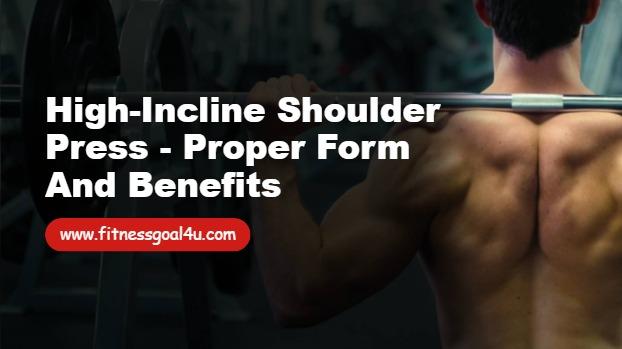
The high-incline shoulder press is a seated overhead pressing movement performed on a bench set at a steep angle, usually between 75 and 85 degrees. This near-vertical position shifts the majority of the workload onto the shoulders, particularly the anterior (front) deltoids, while minimizing chest involvement compared to lower incline or flat presses.
It can be executed with a barbell, dumbbells, or machines. The high angle makes it an excellent choice for isolating the upper shoulders and building that rounded, capped look many lifters seek.
How to Perform the High-Incline Shoulder Press (Step-by-Step Technique)
Safety and control are critical due to the demanding shoulder position.
- Adjust the bench to 75-85 degrees—close to upright but still providing back support.
- Sit with your back flat against the pad, feet planted firmly on the floor, and core braced.
- Grip the barbell slightly wider than shoulder-width or hold dumbbells at shoulder height with palms facing forward.
- Unrack the bar or position the dumbbells so the weight starts just above your upper chest or beside your shoulders.
- Keep your head neutral and scapulae slightly retracted.
- Lower the weight under control until the bar lightly touches your upper chest or the dumbbells reach ear level.
- Press powerfully upward along the same path until arms are nearly locked out.
- Repeat smoothly without bouncing or excessive arching.
Use a spotter for heavy barbell sets and avoid locking elbows aggressively to maintain shoulder safety.
Why Do the High-Incline Shoulder Press? (Benefits)
This exercise provides targeted advantages for shoulder development:
- Superior anterior deltoid emphasis: The steep angle places maximum stress on the front shoulders.
- Creates fuller, rounder delts: Builds the upper portion for enhanced shoulder width and aesthetics.
- Minimal chest recruitment: Allows true shoulder isolation on push days.
- Improves overhead strength: Strengthens the vertical pressing pattern for better performance in standing presses.
- Reduced lower back stress: Seated support eliminates strain compared to standing variations.
- Scalable progression: Easy to increase weight gradually while maintaining strict form.
- Great accessory movement: Complements flat bench and standing presses for balanced development.
Recommended Sets and Repetitions
Select volume according to your primary goal.
| Goal | Sets | Reps | Rest Between Sets |
|---|---|---|---|
| Strength | 4-5 | 5-8 | 2-3 minutes |
| Hypertrophy (Muscle Growth) | 3-4 | 8-12 | 60-90 seconds |
| Endurance | 3 | 12-15+ | 45-60 seconds |
Include it 1-2 times per week, preferably early in your shoulder or push session when fresh.
FAQ (Frequently Asked Questions)
1. What is the optimal bench angle for high-incline shoulder press?
Answer: 75-85 degrees is ideal. This range maximizes shoulder activation while still allowing safe back support and natural bar path.
2. Is high-incline press better for shoulders than flat bench press?
Answer: Yes, for targeting the deltoids specifically. Flat bench emphasizes the chest more, while high-incline shifts focus to the front and upper shoulders.
3. Which muscles does the high-incline shoulder press primarily work?
Answer: The anterior and medial deltoids are the main movers, with strong support from the triceps and some upper chest and traps.
4. Should I use dumbbells or a barbell?
Answer: Both work well. Dumbbells offer a freer range of motion and help correct imbalances; barbell allows heavier loading for strength progression.
5. Can this exercise cause shoulder discomfort?
Answer: It can if form is poor or weight is too heavy. Keep controlled tempo, avoid dropping too low, and warm up thoroughly to protect the joints.
6. How often should I perform high-incline shoulder presses?
Answer: 1-2 times per week is optimal. Allow at least 48 hours between heavy shoulder sessions for recovery.
7. Is it suitable for beginners?
Answer: Yes, but start with light weight and moderate incline (around 70 degrees) to build confidence and proper mechanics first.
8. Should I lock out my elbows at the top?
Answer: A controlled near-lockout is fine to maintain tension on the deltoids. Avoid forcefully hyperextending the elbows.